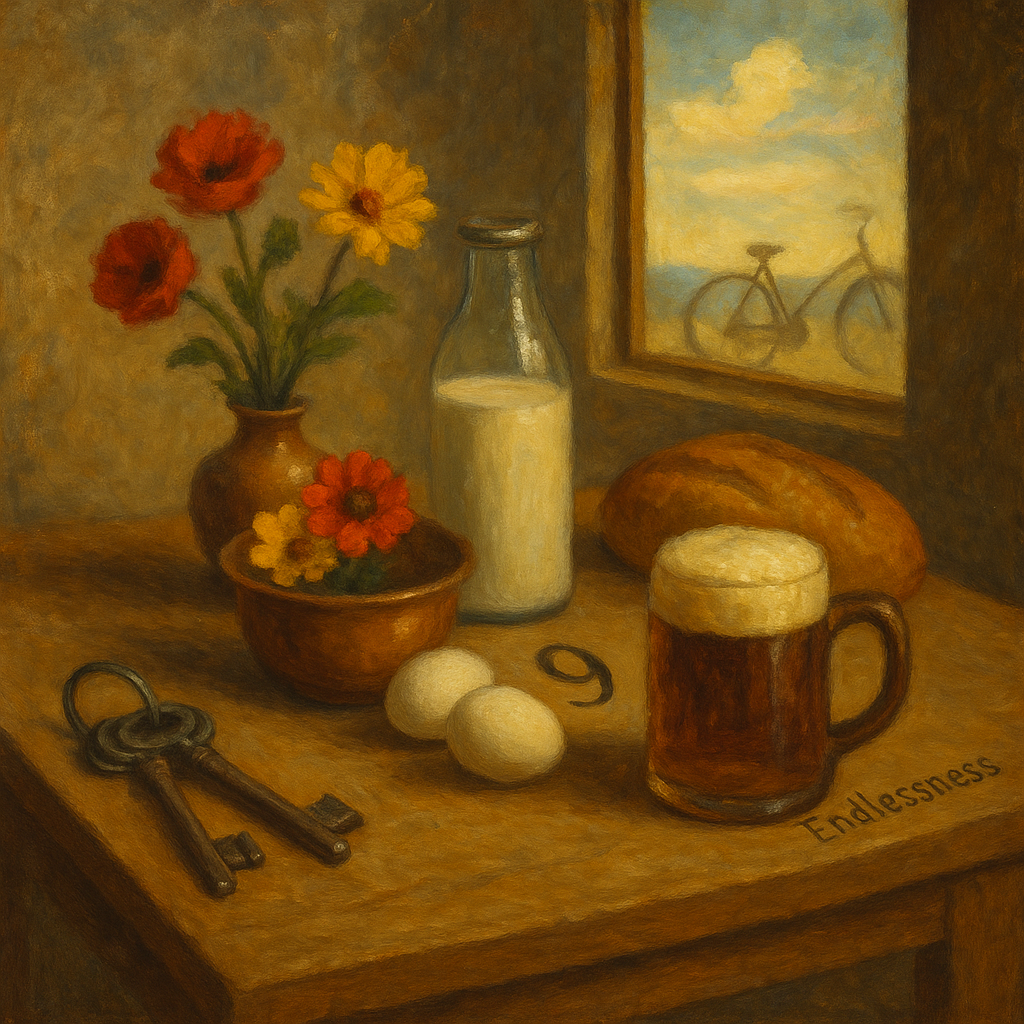
TABLE

Table
by EDIP CANSEVER (Turkish Poet)
translated by Julia Clare Tillinghast and Richard Tillinghast

A man filled with the gladness of living
Put his keys on the table,
Put flowers in a copper bowl there.
He put his eggs and milk on the table.
He put there the light that came in through the window,
Sound of a bicycle, sound of a spinning wheel.
The softness of weather and bread he put there.
On the table the man put
Things that happened in his mind.
What he wanted to do in life,
He put that there.
Those he loved, those he didn’t love,
The man put them on the table too.
Three times three make nine:
The man put nine on the table.
He was next to the window next to the sky;
He reached out and placed on the table endlessness.
So many days he had wanted to drink a beer!
He put on the table the pouring of that beer.
He placed there his sleep and his wakefulness;
His hunger and his fullness he put there.
Now that’s what I call a table!
It didn’t complain at all about the load.
It wobbled once or twice, then stood firm.
The man kept piling things on.

From Dirty August: Poems by Edip Cansever, translated by Julia Clare Tillinghast and Richard Tillinghast Jersey City, NJ: Talisman House, 2009

This fascinating poem is a poetic listing — a catalogue of the self. The act of putting things on the table becomes a ritual of unburdening, of both confession and celebration. It starts with piling up of essentials that brought joy to the poet’s life. The table soon becomes a microcosm of a life — joys, regrets, hunger, memory, love, rejection, longing — all coexist. I believe everyone has such a table.

Edip Cansever’s poem “Table” is a deeply evocative and symbolic celebration of life, memory, and the human experience — all unfolding on a simple, unassuming piece of furniture: a table. With deceptive simplicity and a meditative rhythm, Cansever turns a household object into a repository of emotion, desire, thought, and even the metaphysical.

The poem uses free verse, lending it a conversational tone, almost like a stream of consciousness. The repetitive phrase “he put” creates a rhythm and builds a cumulative effect — each object placed on the table adding to the complexity of the speaker’s inner and outer worlds. The tone is reflective, sometimes playful, but increasingly profound as abstract ideas begin to mingle with physical things. There’s a quiet reverence toward the ordinary, transforming the mundane into something sacred.

Cansever begins with concrete, everyday items:“Put his keys on the table, / Put flowers in a copper bowl there.” As the poem progresses, he layers sensory perceptions (“light,” “sound”), then moves into the intangible:“Things that happened in his mind… / What he wanted to do in life.” Eventually, the poet arrives at the cosmic — placing “endlessness” itself on the table. This evolution from the simple to the sublime echoes human consciousness and our natural tendency to attach meaning to the ordinary.

Edip Cansever’s “Table” is a meditative marvel — a still life that moves. The poem does not preach or dramatize but simply places before us the quiet abundance of living. In its simplicity lies its profundity. The final image — of the table, firm despite its load — becomes a poetic monument to human resilience, memory, and the art of noticing. This is a poem that doesn’t ask to be analysed so much as inhabited, much like the table itself — inviting us to place our own “pouring of beer,” our “softness of bread,” and our “endlessness” on it, and see how it holds.

What would your table be?

THE POEM I CAN’T YET NAME

THE POEM I CAN’T YET NAME
By Nguyen Phan Que Mai (Vietnamese Poet)
Translated by Bruce Weigl (American Poet)

My hands lift high a bowl of rice, the seeds harvested
in the field where my grandmother was laid to rest.
Each rice seed tastes sweet as the sound of lullaby
from the grandmother I never knew.
I imagine her soft face as they laid her down into the earth,
her clothes battered, her skin stuck to her bones;
in the Great Hunger of 1945*, my village
was starved for graves to bury all the dead.
Nobody could find my grandmother’s grave,
so my father tasted bitter rice for sixty-five years.

After sixty-five years of searching,
spirits of my ancestors led my father and me
to my grandmother’s grave.
I heard my father call “Mum,” for the first time;
the rice field behind his back trembled.

My feet clung to the mud.
I listened in the burning incense how my grandmother’s soul
spread,
joining the earth, taking root in the field,
where she quietly sang lullabies, calling the rice plants to blossom.

Lifting the bowl of rice in my hands, I count every seed,
each one glistening with the sweat of my ancestors,
their backs bent in the rice fields,
the fragrance of my grandmother’s lullaby alive on each one.

* The Vietnamese Famine of 1945 occurred in northern Vietnam from October 1944 to May 1945, during the Japanese occupation of French Indochina in World War II. Between 400,000 and 2 million people are estimated to have starved to death during this time.

Born into the Vietnam War in 1973, Nguyen Phan Que Mai grew up witnessing the war’s devastation and its aftermath. She worked as a street vendor and rice farmer before winning a scholarship to attend university in Australia. Upon her return to Vietnam, Que Mai contributed to the sustainable development of her homeland via her work with local and international organizations including UN agencies. She is the author of eight books of poetry, fiction, and non-fiction in Vietnamese.

Her poems are fiercely loyal to the sentiments they gracefully express, which is what we mean when we talk about honesty in poetry. Ms. Nguyen is never hesitant to take on grand ideas, and never hesitant to rely on a sometimes raw and direct talk in order to expose the phenomena of our lives. She is a poet of a Vietnamese version of romanticism, in which she finds her subjects among the so-called ordinary lives of so-called ordinary people, and she celebrates not the accomplishments of kings or emperors, but of regular Vietnamese citizens, like the grandma in the poem, who have struggled to stay alive, feed their families, and find their way back home after long, war-inflicted years of exile and despair. Hers is a poetry that instructs us on how to live more fully in the world, and reaffirms the power of clear-headed and direct poetry to transform even our darkest hours into deeply abiding lessons on the complexities of

Nguyen Phan Que Mai’s “The Poem I Can’t Yet Name” is a tender and elegiac tribute to ancestry, memory, survival, and the sacredness of daily life. Rooted in personal and national history, this poem weaves together the trauma of war and famine with the resilience of generational love — especially the enduring presence of a grandmother the poet never met.

The tone is gentle, reverent, and quietly grieving, but never sentimental. It moves with the steady rhythm of ritual — of lifting rice, burning incense, bowing to memory. There is deep emotion in the poet’s voice, but it is controlled, restrained — shaped by respect and cultural humility.
Rice is central to the poem — not just as food, but as symbol. Each grain is rich with meaning:
“Each rice seed tastes sweet as the sound of lullaby / from the grandmother I never knew.”
Here, rice becomes a carrier of memory and maternal affection. It replaces the lost lullabies with nourishment. It is the body of the land and the body of the grandmother, feeding generations forward.

In the final lines, the speaker reflects:
“each one glistening with the sweat of my ancestors… the fragrance of my grandmother’s lullaby alive on each one.”
This elevates rice to a sacred, spiritual substance — a form of continuity, presence, and song. The act of eating rice becomes an act of remembrance and reverence.

As mentioned earlier the poem references a real and devastating historical event — the Vietnamese famine of 1945, in which over a million people died. The line:
“my village / was starved for graves to bury all the dead.”
is harrowing in its simplicity. The horror is not dramatized — it’s told with quiet devastation, making it all the more powerful. This sets the foundation for a deeply personal loss: the grandmother’s grave was lost amid mass death, and the father grew up without closure, tasting “bitter rice for sixty-five years.”

The poem builds toward the discovery of the grandmother’s resting place:
“spirits of my ancestors led my father and me / to my grandmother’s grave.”
There’s a spiritual dimension here — not mystical in a fantastical way, but deeply rooted in Vietnamese ancestral belief and rural sensibility. The land holds memory. Spirits guide the living.
“I heard my father call ‘Mum,’ for the first time.”
This is a moment of catharsis — the release of a son’s lifelong silence, the restoration of a broken link in the family chain. That the “rice field behind his back trembled” suggests that the earth itself acknowledges the reunion.

The poem is free verse, flowing like a stream of memory and reverence. Its images are earthy and tactile. There’s a fusion of body, earth, and spirit throughout the poem. The grandmother’s soul does not simply rest — it “joins the earth, takes root in the field”, singing lullabies to the rice itself.

This poem is as much about personal healing as it is about cultural survival — how memory, food, and ritual preserve identity and dignity even in the aftermath of unimaginable suffering.

To conclude, “The Poem I Can’t Yet Name” is a deeply moving elegy that speaks in whispers — but those whispers carry generations of grief, resilience, and reverence. Nguyen Phan Que Mai writes with a clarity and calmness that makes the emotional weight even more powerful. With rice as its central metaphor, the poem connects body, land, spirit, and memory into one sacred act of remembrance.

It is not just a poem about mourning — it is a poem about belonging, and how the dead continue to nourish the living.

Ref: The Secret of Hoa Sen by Nguyen Phan Que Mai. Translated by Bruce Weigl

The Half-Finished Heaven

The Half-Finished Heaven

By Tomas Tranströmer

Translated by Robin Fulton

Despondency breaks off its course.
Anguish breaks off its course.
The vulture breaks off its flight.

The eager light streams out,
even the ghosts take a draught.

And our paintings see daylight,
our red beasts of the ice-age studios.

Everything begins to look around.
We walk in the sun in hundreds.

Each man is a half-open door
leading to a room for everyone.

The endless ground under us.

The water is shining among the trees.

The lake is a window into the earth.

Tomas Tranströmer’s The Half-Finished Heaven is a luminous and redemptive poem that captures the sudden breaking of despair by glimpses of hope and illumination. The Swedish Nobel laureate, known for his sparse but emotionally rich language, distills a vast emotional and spiritual shift into just a few carefully chosen images and lines.

The poem opens in darkness — with “despondency,” “anguish,” and even a “vulture” — symbols of death, hopelessness, and sorrow. But this heaviness is disrupted. The phrase “breaks off its course” suggests that suffering, though powerful, is not endless. There is an abrupt, almost miraculous intervention: “The eager light streams out.” It’s not passive light but eager — hungry to redeem, to touch, to restore.

From that turning point, the world awakens. Even “ghosts,” symbols of lingering sorrow or memory, are revived — “take a draught” — as if nourished by the new light. Tranströmer then introduces metaphors of art: “our paintings see daylight,” and “red beasts of the ice-age studios.” These suggest that even what was buried deep within human history or psyche — our primal instincts, ancient creations — are returning to view, revitalized.

The lines “Each man is a half-open door / leading to a room for everyone” are especially powerful. They evoke the possibility of connection, empathy, and community. We are not complete or perfect (“half-open”), but we are entryways to something larger, something hospitable. This idea makes the title The Half-Finished Heaven feel apt — the world is incomplete but leaning toward beauty and redemption.

The closing lines bring in elements of nature: “The water is shining among the trees,” and “The lake is a window into the earth.” These observations feel sacred — as though the earth itself is opening up to understanding.Overall, The Half-Finished Heaven is a quietly stunning meditation on the