Jean Follain (1903–1971) was a French poet known for his minimalist lyricism, evoking ordinary moments charged with quiet transcendence. “Event” encapsulates his recurring theme: the extraordinary hidden within the everyday, seen through the lens of acute awareness and emotional sensitivity.
The poem’s central idea is contained in its opening line:
“Everything is an event / for those who know how to tremble.”
Follain suggests that true perception requires vulnerability—to “tremble” is to feel deeply, to be open to the smallest details of existence. For such people, even the mundane becomes momentous: a drop of water, falling, carries within in it the image of whole landscape . “The sound of a pin / falling on marble” evokes both fragility and precision—a moment so delicate it becomes monumental in stillness.
“Milk boiling / at day’s end” places us in a domestic setting, ordinary yet intimate, contrasting with the metaphysical scope of the opening lines.
The poem democratizes experience—no hierarchy exists between great historical events and the quiet gestures of domestic life. Everything matters, provided we are capable of sensing it.
“Event” captures Follain’s belief that poetry resides in perception, not in the magnitude of what is perceived. The poem is almost a moral statement: to live fully, one must remain sensitive enough to tremble at life’s smallest occurrences.
By Jean Follain ( French Minimalist poet) Translated by Heather McHugh
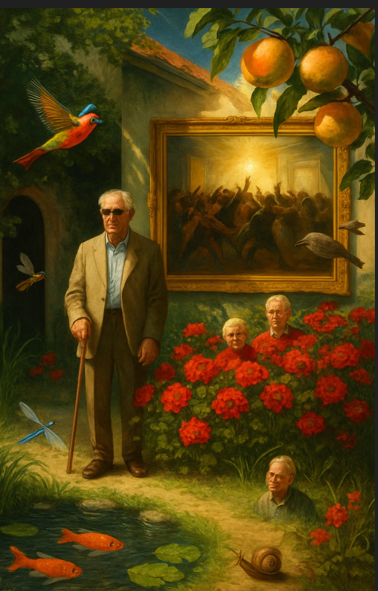
Insects and fish move from the shade to the light the fruit hangs still on the tree brushed by the fine wing of a flamboyant bird then a dull one. The blind man hardly thinks of his missing eyes in the garden of wine-red flowers. Suddenly the sun in the drawing room lights a large painting that shows rioters surging wildly into sight.
A delicate and layered poem, “The Beautiful Day” uses serene imagery and subtle shifts in tone to reflect on how easily tranquility can be shadowed by unseen violence or remembered suffering. It unfolds with a deep awareness of contrast—between serenity and disturbance, the visible and the hidden, nature and human turmoil. It’s a meditation on the fragility of peace and the haunting presence of what lies beyond the beautiful moment.
By moving from a garden’s quiet details to a painting of rioters lit up indoors, the poem subtly asks us about what we see, what we miss, and how sudden revelations (of violence, of reality) change the character of a peaceful day. It’s a poem about beauty and disturbance, perception and ignorance, outer calm and inner turmoil.
Heather McHugh in her introduction says the following about the poem:
“And in “The Beautiful Day,” the aristocratic idleness of the garden (appearing for all the world—*brushed,” posed—like the subject of a more romantic art) is disturbed by the image of the insurgent mob in a living-room painting. Which is more alive, more real? We feel we know. We know we feel. Still, the man in the garden is blind. The seer is present in these poems not as the fashionably poetic first person but rather as the subverted designer of the seen. We, the readers, have a place here too. Is it we who lull, senseless, in the garden of the decorative, blind to the blood in the living room? The poem s both subject and object here.”
Source : D’Apres Tout: Poems by Jean Follain. Image created using AI)
Halina Poświatowska (Polish Lyric poet) Translated by Maya Peretz
if you die I won’t put on a lilac dress won’t buy colored wreaths with whispering wind in the ribbons none of that none
the hearse will come — will comethe hearse will go — will go I’ll stand at the window — I’ll look wave my hand flutter my handkerchief bid farewell alone in that window
and in summer in crazy May I will lie down on the grass warm grass and with my hands will touch your hair and with my lips will touch a bee’s pelt prickly and beautiful like your smile like dusk
later it will be silver — golden perhaps golden and only red for that dusk that wind which whispers love into grasses stubbornly whispers love will not allow me to rise and go so simply to my cursed deserted house
(From : Indeed I love… : Selected Poems of Halina Poświatowska)
Poświatowska is famous for her lyrical poetry, and for her intellectual, passionate yet unsentimental poetry on the themes of death, love, existence, famous historical personages, especially women, as well as her mordant treatment of life, living, being, bees, cats and the sensual qualities of loving, grieving and desiring. (Wiki). Sadly, she died at the age of 32.
This poem is a quietly devastating meditation on grief, love, memory, and the raw, unresolved emotions that accompany loss. In a style that is both intimate and elusive, she rewrites the rituals of mourning into something more personal, elemental, and sensual.
The tone is restrained and almost dispassionate at first — “if you die / I won’t put on a lilac dress” — rejecting traditional mourning practices and ceremonial grief. But under the surface, this emotional flatness conceals a profound depth of love and vulnerability. The voice is solitary, meditative, and deeply personal — as if the speaker is speaking not to us, but directly to the beloved (possibly already lost).
The poem is built in two parts: the first coolly dismisses outward mourning rituals; the second opens into a lyrical outpouring of natural imagery that becomes the speaker’s private language of grief. Rather than the expected flowers and ribbons — “colored wreaths / with whispering wind in the ribbons” — she offers a stark image of detachment: standing alone at the window, waving a handkerchief. But then, in the second half, she transforms grief into a tactile communion with nature:
“I will lie down on the grass / warm grass / and with my hands will touch your hair / and with my lips will touch a bee’s pelt”
Here, Poświatowska fuses the sensory world — grass, bees, hair, wind — with the emotional and metaphysical. The bee’s pelt, “prickly and beautiful,” becomes a metaphor for the beloved’s smile, for the sting and sweetness of memory. The dusk, golden and red, echoes the complexity of letting go — a moment suspended between light and darkness.The final lines resist closure. Even the wind becomes an accomplice, “whispers love into grasses / stubbornly whispers love.” This persistent whisper of love paralyzes the speaker — she cannot “rise and go / so simply.”
Like John Donne, Poświatowska offers a deeply sensual and metaphysical approach to mourning, where nature becomes both witness and medium of love and grief. KEEP IN MIND is a tender rebellion against formal rituals, and a haunting portrait of loss — not as an ending, but as a transformation of love into something eternal, diffused into the elements.
Table by EDIP CANSEVER (Turkish Poet) translated by Julia Clare Tillinghast and Richard Tillinghast
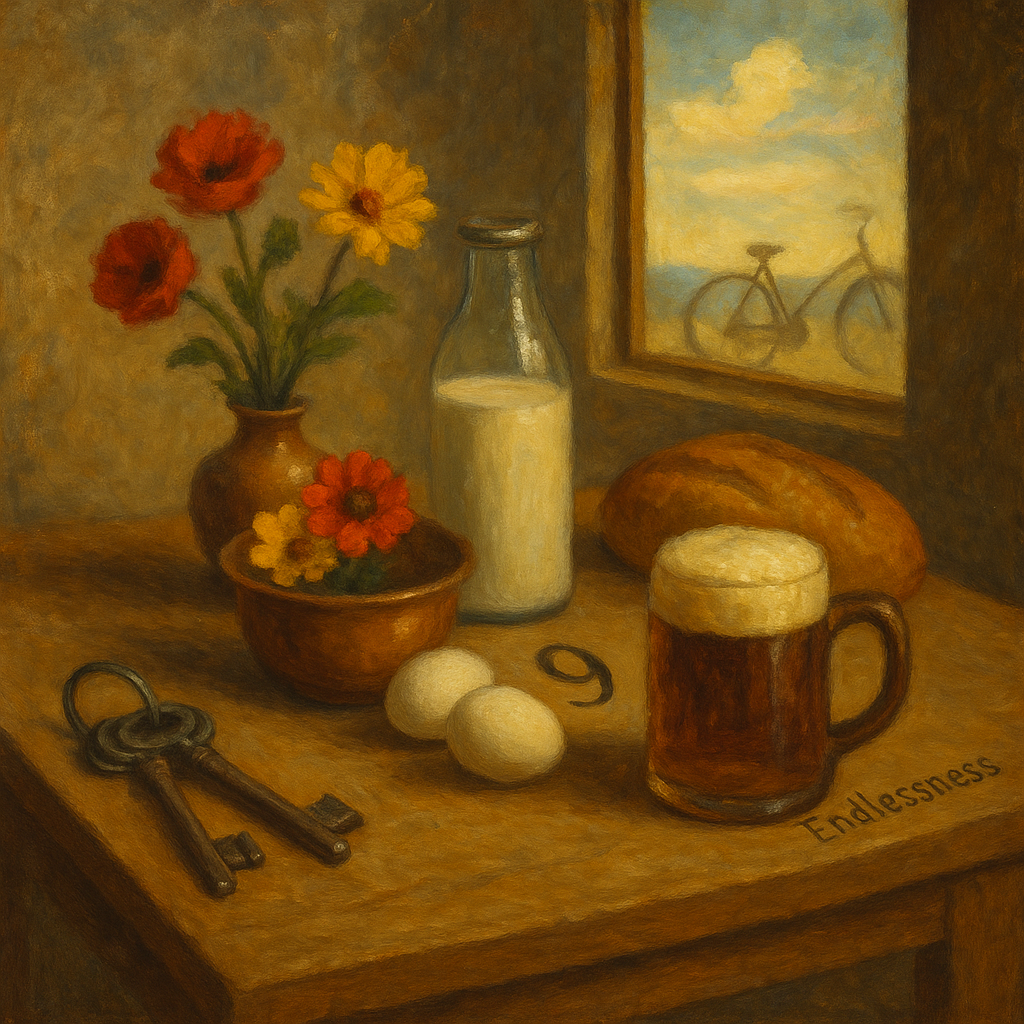
A man filled with the gladness of living Put his keys on the table, Put flowers in a copper bowl there. He put his eggs and milk on the table. He put there the light that came in through the window, Sound of a bicycle, sound of a spinning wheel. The softness of weather and bread he put there. On the table the man put Things that happened in his mind. What he wanted to do in life, He put that there. Those he loved, those he didn’t love, The man put them on the table too. Three times three make nine: The man put nine on the table. He was next to the window next to the sky; He reached out and placed on the table endlessness. So many days he had wanted to drink a beer! He put on the table the pouring of that beer. He placed there his sleep and his wakefulness; His hunger and his fullness he put there. Now that’s what I call a table! It didn’t complain at all about the load. It wobbled once or twice, then stood firm. The man kept piling things on.
From Dirty August: Poems by Edip Cansever, translated by Julia Clare Tillinghast and Richard Tillinghast Jersey City, NJ: Talisman House, 2009
This fascinating poem is a poetic listing — a catalogue of the self. The act of putting things on the table becomes a ritual of unburdening, of both confession and celebration. It starts with piling up of essentials that brought joy to the poet’s life. The table soon becomes a microcosm of a life — joys, regrets, hunger, memory, love, rejection, longing — all coexist. I believe everyone has such a table.
Edip Cansever’s poem “Table” is a deeply evocative and symbolic celebration of life, memory, and the human experience — all unfolding on a simple, unassuming piece of furniture: a table. With deceptive simplicity and a meditative rhythm, Cansever turns a household object into a repository of emotion, desire, thought, and even the metaphysical.
The poem uses free verse, lending it a conversational tone, almost like a stream of consciousness. The repetitive phrase “he put” creates a rhythm and builds a cumulative effect — each object placed on the table adding to the complexity of the speaker’s inner and outer worlds. The tone is reflective, sometimes playful, but increasingly profound as abstract ideas begin to mingle with physical things. There’s a quiet reverence toward the ordinary, transforming the mundane into something sacred.
Cansever begins with concrete, everyday items:“Put his keys on the table, / Put flowers in a copper bowl there.” As the poem progresses, he layers sensory perceptions (“light,” “sound”), then moves into the intangible:“Things that happened in his mind… / What he wanted to do in life.” Eventually, the poet arrives at the cosmic — placing “endlessness” itself on the table. This evolution from the simple to the sublime echoes human consciousness and our natural tendency to attach meaning to the ordinary.
Edip Cansever’s “Table” is a meditative marvel — a still life that moves. The poem does not preach or dramatize but simply places before us the quiet abundance of living. In its simplicity lies its profundity. The final image — of the table, firm despite its load — becomes a poetic monument to human resilience, memory, and the art of noticing. This is a poem that doesn’t ask to be analysed so much as inhabited, much like the table itself — inviting us to place our own “pouring of beer,” our “softness of bread,” and our “endlessness” on it, and see how it holds.
THE POEM I CAN’T YET NAME By Nguyen Phan Que Mai (Vietnamese Poet) Translated by Bruce Weigl (American Poet)
My hands lift high a bowl of rice, the seeds harvested in the field where my grandmother was laid to rest. Each rice seed tastes sweet as the sound of lullaby from the grandmother I never knew. I imagine her soft face as they laid her down into the earth, her clothes battered, her skin stuck to her bones; in the Great Hunger of 1945*, my village was starved for graves to bury all the dead. Nobody could find my grandmother’s grave, so my father tasted bitter rice for sixty-five years.
After sixty-five years of searching, spirits of my ancestors led my father and me to my grandmother’s grave. I heard my father call “Mum,” for the first time; the rice field behind his back trembled.
My feet clung to the mud. I listened in the burning incense how my grandmother’s soul spread, joining the earth, taking root in the field, where she quietly sang lullabies, calling the rice plants to blossom.
Lifting the bowl of rice in my hands, I count every seed, each one glistening with the sweat of my ancestors, their backs bent in the rice fields, the fragrance of my grandmother’s lullaby alive on each one.
* The Vietnamese Famine of 1945 occurred in northern Vietnam from October 1944 to May 1945, during the Japanese occupation of French Indochina in World War II. Between 400,000 and 2 million people are estimated to have starved to death during this time.
Born into the Vietnam War in 1973, Nguyen Phan Que Mai grew up witnessing the war’s devastation and its aftermath. She worked as a street vendor and rice farmer before winning a scholarship to attend university in Australia. Upon her return to Vietnam, Que Mai contributed to the sustainable development of her homeland via her work with local and international organizations including UN agencies. She is the author of eight books of poetry, fiction, and non-fiction in Vietnamese.
Her poems are fiercely loyal to the sentiments they gracefully express, which is what we mean when we talk about honesty in poetry. Ms. Nguyen is never hesitant to take on grand ideas, and never hesitant to rely on a sometimes raw and direct talk in order to expose the phenomena of our lives. She is a poet of a Vietnamese version of romanticism, in which she finds her subjects among the so-called ordinary lives of so-called ordinary people, and she celebrates not the accomplishments of kings or emperors, but of regular Vietnamese citizens, like the grandma in the poem, who have struggled to stay alive, feed their families, and find their way back home after long, war-inflicted years of exile and despair. Hers is a poetry that instructs us on how to live more fully in the world, and reaffirms the power of clear-headed and direct poetry to transform even our darkest hours into deeply abiding lessons on the complexities of
Nguyen Phan Que Mai’s “The Poem I Can’t Yet Name” is a tender and elegiac tribute to ancestry, memory, survival, and the sacredness of daily life. Rooted in personal and national history, this poem weaves together the trauma of war and famine with the resilience of generational love — especially the enduring presence of a grandmother the poet never met.
The tone is gentle, reverent, and quietly grieving, but never sentimental. It moves with the steady rhythm of ritual — of lifting rice, burning incense, bowing to memory. There is deep emotion in the poet’s voice, but it is controlled, restrained — shaped by respect and cultural humility. Rice is central to the poem — not just as food, but as symbol. Each grain is rich with meaning: “Each rice seed tastes sweet as the sound of lullaby / from the grandmother I never knew.” Here, rice becomes a carrier of memory and maternal affection. It replaces the lost lullabies with nourishment. It is the body of the land and the body of the grandmother, feeding generations forward.
In the final lines, the speaker reflects: “each one glistening with the sweat of my ancestors… the fragrance of my grandmother’s lullaby alive on each one.” This elevates rice to a sacred, spiritual substance — a form of continuity, presence, and song. The act of eating rice becomes an act of remembrance and reverence.
As mentioned earlier the poem references a real and devastating historical event — the Vietnamese famine of 1945, in which over a million people died. The line: “my village / was starved for graves to bury all the dead.” is harrowing in its simplicity. The horror is not dramatized — it’s told with quiet devastation, making it all the more powerful. This sets the foundation for a deeply personal loss: the grandmother’s grave was lost amid mass death, and the father grew up without closure, tasting “bitter rice for sixty-five years.”
The poem builds toward the discovery of the grandmother’s resting place: “spirits of my ancestors led my father and me / to my grandmother’s grave.” There’s a spiritual dimension here — not mystical in a fantastical way, but deeply rooted in Vietnamese ancestral belief and rural sensibility. The land holds memory. Spirits guide the living. “I heard my father call ‘Mum,’ for the first time.” This is a moment of catharsis — the release of a son’s lifelong silence, the restoration of a broken link in the family chain. That the “rice field behind his back trembled” suggests that the earth itself acknowledges the reunion.
The poem is free verse, flowing like a stream of memory and reverence. Its images are earthy and tactile. There’s a fusion of body, earth, and spirit throughout the poem. The grandmother’s soul does not simply rest — it “joins the earth, takes root in the field”, singing lullabies to the rice itself.
This poem is as much about personal healing as it is about cultural survival — how memory, food, and ritual preserve identity and dignity even in the aftermath of unimaginable suffering.
To conclude, “The Poem I Can’t Yet Name” is a deeply moving elegy that speaks in whispers — but those whispers carry generations of grief, resilience, and reverence. Nguyen Phan Que Mai writes with a clarity and calmness that makes the emotional weight even more powerful. With rice as its central metaphor, the poem connects body, land, spirit, and memory into one sacred act of remembrance.
It is not just a poem about mourning — it is a poem about belonging, and how the dead continue to nourish the living.
Ref: The Secret of Hoa Sen by Nguyen Phan Que Mai. Translated by Bruce Weigl
Despondency breaks off its course. Anguish breaks off its course. The vulture breaks off its flight.
The eager light streams out, even the ghosts take a draught.
And our paintings see daylight, our red beasts of the ice-age studios.
Everything begins to look around. We walk in the sun in hundreds.
Each man is a half-open door leading to a room for everyone.
The endless ground under us.
The water is shining among the trees.
The lake is a window into the earth.
Tomas Tranströmer’s The Half-Finished Heaven is a luminous and redemptive poem that captures the sudden breaking of despair by glimpses of hope and illumination. The Swedish Nobel laureate, known for his sparse but emotionally rich language, distills a vast emotional and spiritual shift into just a few carefully chosen images and lines.
The poem opens in darkness — with “despondency,” “anguish,” and even a “vulture” — symbols of death, hopelessness, and sorrow. But this heaviness is disrupted. The phrase “breaks off its course” suggests that suffering, though powerful, is not endless. There is an abrupt, almost miraculous intervention: “The eager light streams out.” It’s not passive light but eager — hungry to redeem, to touch, to restore.
From that turning point, the world awakens. Even “ghosts,” symbols of lingering sorrow or memory, are revived — “take a draught” — as if nourished by the new light. Tranströmer then introduces metaphors of art: “our paintings see daylight,” and “red beasts of the ice-age studios.” These suggest that even what was buried deep within human history or psyche — our primal instincts, ancient creations — are returning to view, revitalized.
The lines “Each man is a half-open door / leading to a room for everyone” are especially powerful. They evoke the possibility of connection, empathy, and community. We are not complete or perfect (“half-open”), but we are entryways to something larger, something hospitable. This idea makes the title The Half-Finished Heaven feel apt — the world is incomplete but leaning toward beauty and redemption.
The closing lines bring in elements of nature: “The water is shining among the trees,” and “The lake is a window into the earth.” These observations feel sacred — as though the earth itself is opening up to understanding.Overall, The Half-Finished Heaven is a quietly stunning meditation on the
There was once a good old couple who lived in a little cottage upon a hilltop. Baucis and Philemon were their names, and, although they were very poor, they tended their bees, and pruned their grape vine, and milked their one cow, and were happy from morning till night. For they loved each other dearly, and they were ready to share whatever they had with any one in need.
At the foot of the hill lay a beautiful village, with pleasant roads, and rich pasture lands all about it; but it was full of wicked, selfish people, who had no love in their hearts, and thought only of themselves.
One evening, as Baucis and Philemon sat in their cottage door, they saw two strangers coming slowly up the hill. There was a great noise of shouting, and the barking of the dogs from the village, for the people were following the strangers, and jeering at them because they were footsore, and ragged, and weary.
“Let us go to meet them,” cried old Baucis, “and ask them to share our supper, and stay with us for the night.” So Baucis and Philemon brought the strangers, who were quite faint for food, to their cottage, and they spread before them all that they had, which was very little—a half a loaf of brown bread, a tiny bit of honey from their own hives, and a pitcher of milk. The pitcher was only partly full, and when Philemon had filled two bowls for the strangers, there was but a drop left.
The strangers ate as if they had never tasted anything as good, although the supper was exceedingly small.
“More of this delicious milk, Philemon!” cried one of the strangers, and, as Philemon took the pitcher to drain the last drop into the bowl, a wonderful fountain of milk burst forth from the bottom of the pitcher, so that the more she poured the more there remained.
And it was so with the loaf, which stayed always the same size, although the two strangers cut slice after slice, praising Philemon for its sweetness and lightness. The honey grew the color of gold, and sweeter each minute; and the single, tiny bunch of grapes grew to a bunch of such size that the strangers were not able to eat it, and the grapes filled all the cottage with their wonderful fragrance.
“These are strange travelers!” whispered the old couple to each other, “who are able to do such marvellous things.” That night Baucis and Philemon slept upon the floor, that the strangers might have their bed; and in the morning they went to the edge of the hill to see the strangers safely started on their homeward way.
“The villagers are thoughtless and rude,” said Baucis. “I hope they may not torment you again, good sirs.”
But the strangers smiled, and pointed to the foot of the hill. There was no village there. Where it had stood a blue lake rippled, covering, with its clear waters, the houses and the trees. Baucis and Philemon rubbed their eyes in wonder. “People with no love in their hearts shall not live upon the earth,” said the strangers. “As for you, my good people, we thank you; and whatever you wish for most, that shall be given you.”
As they spoke, the strangers vanished from sight, like mist in the morning sky; and Baucis and Philemon turned to see that their tiny cottage had disappeared also, and in its place stood a tall, white marble palace, with a beautiful park all about.
So the old couple went in, and they lived in their palace a great, great while, taking good care of their wonderful pitcher. No one ever passed their door without having a drink from the bubbling fountain of milk, and Baucis and Philemon were so happy doing good deeds for others that they never thought of wishing for anything for themselves. But, after years and years had passed they grew very old.
“I wish we might never die, but could always stay together!” said Baucis, one day, to Philemon.
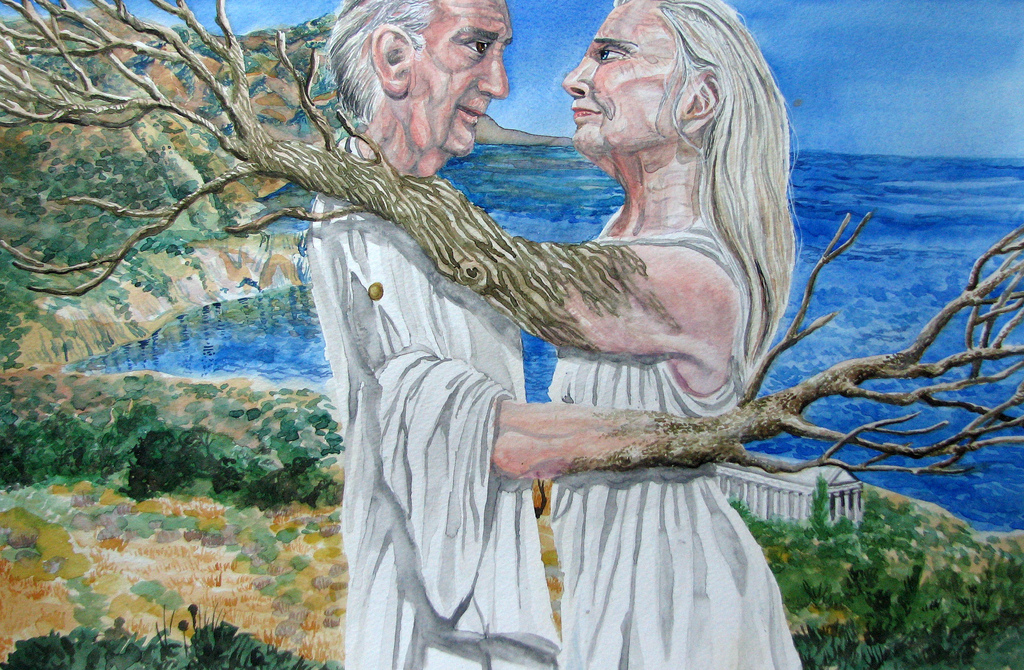
The next morning, where the tall marble palace had stood, there was nothing save a few stones with the moss growing over them; Philemon and Baucis were gone; but there, on the hilltop, stood two beautiful trees—an oak tree and a linden—with their branches all twined and twisted together.
“I am old Baucis!” whispered the oak.
“I am Philemon!” sighed the linden—and there they stand to-day, quite close to each other, and always ready to spread their leafy shade over every tired stranger who chances to climb the hill. ……………………………………………………………………………………………. You may now read the beautiful lines from a famous poem titled “Letter of Testimony” by Octavio Paz as it extols the creative power of love. Coda Perhaps to love is to learn to walk through this world. To learn to be silent like the oak and the linden of the fable. To learn to see. Your glance scattered seeds. It planted a tree. I talk because you shake its leaves. (Translated by Eliot Weinberger)
The first few phrases of the poem are a sort of definition (if such a thing were possible) of love; like any great poet, Paz presents a wholly new way of looking at his subject. I especially like the line “to love… is to learn to be silent” – it conveys a truth lost in many more verbose descriptions of the emotion.
The silence of the forest (“the oak and the linden of the fable”) leads naturally into the analogy of the second half:”Your glance scattered seeds / It planted a tree”. Again, the metaphor is neither forced nor is it taken too far; the final line comes as a natural (and beautiful) conclusion to the whole.
Notice how the rather abstract infinitives with which ‘Coda’ starts (to love, to learn, to walk, to see, to be silent) give way to more concrete actions later on – ‘scattered’, ‘planted’, ‘talk’ and ‘shake’. The result is to move the poem from the general to the specific: from a discussion of ‘Love’ as an abstract concept, to words and sentences addressed directly to the poet’s beloved. This is a fairly common poetic device, but one no less pleasing for that; I like the delicate and unobtrusive skill with which it’s done in this poem.
Octavio Paz (my favorite poet) was the foremost Mexican poet of the 20th century. He won the Nobel Prize for literature in 1990. He was also the former Mexican Ambassador to India. I had featured earlier two of his works, “The Blue Bouquet” and “January First” .
Ref: The collected poems of Octavio Paz, 1957-1987 By Octavio Paz, Eliot Weinberger (Page 635)
(Translated by Clare Cavanagh and Stanislaw Baranczak)
Life is the only way to get covered in leaves, catch your breath on the sand, rise on wings;
to be a dog, or stroke its warm fur;
to tell pain from everything it’s not;
to squeeze inside events, dawdle in views, to seek the least of all possible mistakes.
An extraordinary chance to remember for a moment a conversation held with the lamp switched off;
and if only once to stumble upon a stone, end up soaked in one downpour or another,
mislay your keys in the grass; and to follow a spark on the wind with your eyes; and to keep on not knowing something important.
The author of this poem is the Nobel Prize winner -Wislawa Szymborska. She is that rarest of phenomena- a serious poet who commanded amazing popularity in her native land as the most representative Polish poet of last century. She is one of the most accessible of all poets I have read and therefore one of my favorite poets.
It’s hard to follow a poetic explanation on Life . Every line in this poem draws a sigh out of the reader. If you take out each line by itself, they might seem quite unpoetic. Or is it that the magic of the poem is in the opening line? It is only when dovetailed with this opening line that the rest of the poem’s lines acquire their magical qualities.
The above poem is a good note on life. There is a reward for being fully open to all of life’s pain and its promise.
Life is the only way…”
It wakes the reader up! We’re all ears now; what is this ‘Life’ thing? Oh let’s see what it’s all about. This is going to be deeply philosophical and wrenching. Intense. But then Szymborska follows it up with all these simple and yet wonderful, wonderful lines that defy any sort of intellectual analysis. It defies them. It denies them the opportunity to probe the poem for this or that with their rude speculative tools. Follows it up with lines that are almost Koan-esque in nature, accessible only to the intuition and leaves the reader with the sense that he/she now shares this secret knowledge of Life with the poet ‘ a knowing, and at the same time a Not Knowing that gives us joy, the joy
“to keep on not knowing something important.”
How nice! The frustrations of not-knowing are an opportunity, one for which to be grateful. We can’t have answers to our biggest questions – but in that piquancy somehow lies our big chance.
Life is the only chance ‘to mislay your keys in the grass’-that must be an intensely romantic moment!..hehe . ‘To tell pain from everything it’s not’- I lifted up my eyes for a momentary flashback after reading that line. ‘a conversation held with the lamp switched off’, I would love this. ‘To squeeze inside events’- some of you who have experienced turbulent times may already be doing that. But the gift of being fully present, ‘to squeeze inside events’, also brings responsibility: to bear witness (like after a holocaust).
There is a stamp of unmistakable originality, playfulness, delightful inventiveness, prodigality of imagination in most of her poems. I love her laconic style and precision. Her poetry is devoid of any affectation and is fresh and full of charm and wit.
Reference: Monologue of a Dog: Wislawa Szymborska (Author), Stanislaw Baranczak (Translator), Clare Cavanagh (Translator), Billy Collins (Foreword). Publisher: Harcourt.
I started my profession as a chemical engineer in a public sector fertilizer company named FACT (Fertilizers and Chemicals Travancore) and soon moved to its design and detailed engineering division called FEDO, which was earlier one of the top five detailed engineering organizations in the petrochemical field in India. In 1994, I was appointed as the project Manager of a grass root Ammonia plant. I used to prepare the minutes of meeting for all progress review meetings and sundry vendor meetings such as for compressors, Boilers, Utility plants, Instrumentation etc. I was even jokingly called the MMOM, the master of minutes of meeting. One day, the Chief projects Manager called me and warned- ‘Look, you are a chemical Engineer. I don’t want you to prepare minutes of meetings that do not pertain to your area. Let the concerned coordinators from each engineering department prepare the minutes of the engineering packages they handle’. I was happy and felt relieved. The following week, we had a discussion with BHEL for a boiler plant. The people who came from Trichy requested me that they wanted to return by evening and wished to carry the minutes with them latest by 5 PM. I conveyed the matter to the new engineering coordinator of Static equipment dept, who had been branded as a tough nut to crack. He cynically looked at me but didn’t say anything. At 5 PM, I went to him to get the minutes. He told me that he had not started writing yet. I was damn upset and I told him that we failed to meet a commitment because of his lax attitude. An argument started and gained momentum very fast. Since both of us had thunder tucked in our mouths, the whole hall of his department reverberated with our alternating arguments. Well, many arguments are sound and only sound. Even people from neighbouring departments came to witness our verbal warfare.
The following day, I went to our General Manager (Project) and explained what had happened. He conceded with my viewpoint. However, a friend of me who had considerable experience in Projects management called me aside and advised -‘PGR, if you want any progress as a project Manager, you shouldn’t fall into an argument trap. As a project Manager, you have to please your engineering coordinators all the times and you need them every day till your project is completed’. He was right. I lifted my phone and apologized to that coordinator for all that happened. Believe me, we had excellent relationship after that inciting incident.
Do you know what issue causes the greatest number of arguments leading to conflicts in households in USA? According to a “USA Today” report, people argue most often about which TV show to watch! Would any couple or family have believed that the selection of television programs would become the major cause of their unhappiness? Well, it could be happening in many households in India as well. They often forget what is important! They stop thinking that relationships are built on love, respect, consideration, kindness, and understanding. They forget all those compelling and wonderful reasons that brought them together in the first place. Instead, they let minor inconveniences trumpet as major issues ripping their relationships. I don’t deny that positive and constructive arguments can be healthy and are a normal part of any relationship; however the problems start when we get into a vicious cycle of arguing about the same thing over and over again. I was reminded of the above incident when I chanced to see some blogs in Sulekha vituperating each other on an inane subject like hosting an EYC contest.
Dear friends, an argument is like a country road; you never know where it is going to lead. The truth is that often it doesn’t lead us anywhere. When an arguer argues dispassionately, he thinks only of the argument. In the process, it produces plenty of heat but not much light. It is often a collision in which two trains of thought are simply derailed. It is very true that the more arguments you win the fewer the friends you will have. Sometimes, silence is one of the hardest arguments to refute.
An argument is question with two sides and no end. More homes and families are destroyed by fusses than funerals. More nations are at war to win their argument than work out an answer.
I wish to conclude my rambling with a poem by the great American poet Carl Sandburg
Elephants are Different to Different People
Wilson and Pilcer and Snack stood before the zoo elephant.
Wilson said, “What is its name? Is it from Asia or Africa? Who feeds it? Is it a he or a she? How old is it? Do they have twins? How much does it cost to feed? How much does it weigh? If it dies, how much will another one cost? If it dies, what will they use the bones, the fat, and the hide for? What use is it besides to look at?” Pilcer didn’t have any questions; he was murmuring to himself, “It’s a house by itself, walls and windows, the ears came from tall cornfields, by God; the architect of those legs was a workman, by God; he stands like a bridge out across the deep water; the face is sad and the eyes are kind;I know elephants are good to babies.” Snack looked up and down and at last said to himself, “He’s a tough son-of-a-gun outside and I’ll bet he’s got a strong heart, I’ll bet he’s strong as a copper-riveted boiler inside.” They didn’t put up any arguments. They didn’t throw anything in each other’s faces. Three men saw the elephant three ways And let it go at that. They didn’t spoil a sunny Sunday afternoon;“Sunday comes only once a week,” they told each other.
This is the way the world should be! Here are three men who are not blind! They don’t fight out their differences and spoil the day. We are all different with our different perspectives. When we lose the right to be different, we lose the privilege to be free.
Let us not spoil this Sunday in arguments. After all, Sunday comes only once in a week.
There are some poems that tug our conscience at the first reading itself. The below one riveted me. I know the Polish writer Ryszard Kapuscinski as one of the great literary journalists of last century , having read many of his books like ‘Emperor’ (On the fall of Ethiopian dictator Haile Selassie), ‘ Another day of life'(his dramatic account of the three months he spent in Angola at the beginning of its decades’ long civil war), ‘Shah of Shah'(on the overthrow of the last Shah of Iran) and my favourite ‘Imperium’ (His account of the collapse of the Soviet system). He spent the last half of twentieth century on the front lines, covering twenty-seven revolutions, rebellions and coups d’état who ranged and wrote across the Middle East, Africa and Latin America and bore witness to the collapse of colonialism in the Third world and the crumbling of Soviet Empire.
I was sceptical when I saw a poetry collection titled ‘I Wrote Stone’ by him in Toronto Public library as I didn’t know he wrote poetry too. This book gathers poetry Kapuscinski wrote over 40 years. Kapuscinski believed poetry could “illuminate dimensions of human experience that otherwise would remain unknowable.” These poems capture the moments between crises, impressions that carry a book-length argument in a few lines. The poems in this slim volume live up to that expectation. It is full of small gems like the one I have posted below. His poetry, so sparing in expression, so simple and transparent, but also melancholic and impassioned enters and affects our psyche. Kapusciniski was nominated several times for Nobel prize in Literature for transforming acts of incisive journalism into stunning works of literature.
.I could easily identify with the moral question and the poignant irony in this poem as I have witnessed this ‘death for life’ many times in my village during my childhood.
YOGI RAMAMURTI
Yogi Ramamurti bids he be buried in a grave he will remain there one week doctors will testify it’s not a scam
whoever wishes can go down the tunnel watch through a window: Ramamurti lies in a grave not breathing
everyone is asked for a donation the buried one wants to earn money that’s why he went to the grave: to survive
after a week they dig up the yogi Ramamurti emerges weakened he’s touched the absolute that’s always exhausting
he bows to the gathering counts the donations 102 rupees less than ten dollars
everyone disperses an empty grave remains Ramamurti was reborn but he’s still a beggar
weeks pass he has nothing to eat he’s dying of hunger
I am going back to the grave he says only in death life
Ryszard Kapuscinski
Ref: I WROTE STONE: The Selected Poetry of Ryszard Kapuscinski . Translated from the Polish by Diana Kuprel and Marek Kusiba. Published by BIBLIOASIS, Canada







 pgrnair.com