Elephants are Different to Different People

Image result for argument painting


I started my profession as a chemical engineer in a public sector fertilizer company named FACT (Fertilizers and Chemicals Travancore) and soon moved to its design and detailed engineering division called FEDO, which was earlier one of the top five detailed engineering organizations in the petrochemical field in India. In 1994, I was appointed as the project Manager of a grass root Ammonia plant. I used to prepare the minutes of meeting for all progress review meetings and sundry vendor meetings such as for compressors, Boilers, Utility plants, Instrumentation etc. I was even jokingly called the MMOM, the master of minutes of meeting. One day, the Chief projects Manager called me and warned- ‘Look, you are a chemical Engineer. I don’t want you to prepare minutes of meetings that do not pertain to your area. Let the concerned coordinators from each engineering department prepare the minutes of the engineering packages they handle’. I was happy and felt relieved. The following week, we had a discussion with BHEL for a boiler plant. The people who came from Trichy requested me that they wanted to return by evening and wished to carry the minutes with them latest by 5 PM. I conveyed the matter to the new engineering coordinator of Static equipment dept, who had been branded as a tough nut to crack. He cynically looked at me but didn’t say anything. At 5 PM, I went to him to get the minutes. He told me that he had not started writing yet. I was damn upset and I told him that we failed to meet a commitment because of his lax attitude. An argument started and gained momentum very fast. Since both of us had thunder tucked in our mouths, the whole hall of his department reverberated with our alternating arguments. Well, many arguments are sound and only sound. Even people from neighbouring departments came to witness our verbal warfare.

The following day, I went to our General Manager (Project) and explained what had happened. He conceded with my viewpoint. However, a friend of me who had considerable experience in Projects management called me aside and advised -‘PGR, if you want any progress as a project Manager, you shouldn’t fall into an argument trap. As a project Manager, you have to please your engineering coordinators all the times and you need them every day till your project is completed’. He was right. I lifted my phone and apologized to that coordinator for all that happened. Believe me, we had excellent relationship after that inciting incident.

Do you know what issue causes the greatest number of arguments leading to conflicts in households in USA? According to a “USA Today” report, people argue most often about which TV show to watch! Would any couple or family have believed that the selection of television programs would become the major cause of their unhappiness? Well, it could be happening in many households in India as well. They often forget what is important! They stop thinking that relationships are built on love, respect, consideration, kindness, and understanding. They forget all those compelling and wonderful reasons that brought them together in the first place. Instead, they let minor inconveniences trumpet as major issues ripping their relationships. I don’t deny that positive and constructive arguments can be healthy and are a normal part of any relationship; however the problems start when we get into a vicious cycle of arguing about the same thing over and over again. I was reminded of the above incident when I chanced to see some blogs in Sulekha vituperating each other on an inane subject like hosting an EYC contest.  

Dear friends, an argument is like a country road; you never know where it is going to lead. The truth is that often it doesn’t lead us anywhere. When an arguer argues dispassionately, he thinks only of the argument. In the process, it produces plenty of heat but not much light. It is often a collision in which two trains of thought are simply derailed. It is very true that the more arguments you win the fewer the friends you will have. Sometimes, silence is one of the hardest arguments to refute.

An argument is question with two sides and no end. More homes and families are destroyed by fusses than funerals. More nations are at war to win their argument than work out an answer.

I wish to conclude my rambling with a poem by the great American poet Carl Sandburg


Elephants are Different to Different People

Wilson and Pilcer and Snack stood before the zoo elephant.

Wilson said, “What is its name? Is it from Asia or Africa? Who feeds it? Is it a he or a she? How old is it? Do they have twins? How much does it cost to feed? How much does it weigh? If it dies, how much will another one cost? If it dies, what will they use the bones, the fat, and the hide for? What use is it besides to look at?” Pilcer didn’t have any questions; he was murmuring to himself, “It’s a house by itself, walls and windows, the ears came from tall cornfields, by God; the architect of those legs was a workman, by God; he stands like a bridge out across the deep water; the face is sad and the eyes are kind;I know elephants are good to babies.” Snack looked up and down and at last said to himself, “He’s a tough son-of-a-gun outside and I’ll bet he’s got a strong heart, I’ll bet he’s strong as a copper-riveted boiler inside.”      They didn’t put up any arguments.      They didn’t throw anything in each other’s faces.      Three men saw the elephant three ways      And let it go at that.      They didn’t spoil a sunny Sunday afternoon;“Sunday comes only once a week,” they told each other.


 This is the way the world should be! Here are three men who are not blind! They don’t fight out their differences and spoil the day. We are all different with our different perspectives. When we lose the right to be different, we lose the privilege to be free.

 Let us not spoil this Sunday in arguments. After all, Sunday comes only once in a week.


THE DINOSAUR

THE DINOSAUR
 Bina Gupta has made a challenging proposition to Sulekha bloggers to write a poem or story of 55 words containing mixed emotions. When I saw that theme, I was reminded of one of the smallest (and one of the best) stories in literature titled ‘The Dinosaur’ by the great Guatemalan writer Augusto Monterroso, who was well-known for his terse minimalist style of writing like that of Hemingway. The story has just nine words:
‘When he woke up, the dinosaur was still there’

A perfect story. Unbeatable power of persuasion, remarkable concision, perfect drama, color, suggestiveness, and clarity. A real minimalist narrative gem. ‘The Dinosaur’ is an interesting piece of writing because its simplicity makes it so complex. Monterroso leaves this text in suspense and offers to the reader an opportunity to become co-fabulator here. This enigmatic work has given rise to numerous doctoral theses.
In the book ‘Letters to a young Novelist’, the great Peruvian Novelist Mario Vargas Llosa discusses this story from the points of view of -the narrator, space, time and Level of reality. I have summarized it below.
The narration in ‘The Dinosaur’ is made in the past tense. So the narrator is situated in the future, narrating something that happened-when? In the near or middle past from the narrator’s future point of view? In the middle past. How do we know that the narrator is situated in the near or middle past in relation to the time of the narrator? Because between those two times there is an unbridgeable abyss, a gap, a barrier that abolishes all link or continuity between the two (The comma). This is the determining characteristic of the tense the narrator employs: The action is confined to a closed- off past, split from the time the narrator inhabits. The action of ‘Dinosaur’ takes place, therefore, in a middle past.
What is the point of view in terms of level of reality in this story? The narrative is situated in the plane of the fantastic, since in the real world you and I inhabit, it is improbable that prehistoric animals that appeared in our dreams–or in our nightmares–would turn up as an objective reality, and that we should encounter them in the flesh at the foot of our beds when we opened our eyes. It’s clear, then, that the level of reality of the narrative is an imaginary or fantastic reality. Is the narrator (omniscient and impersonal) situated on the same plane? We could venture to say that he is not, that he establishes himself instead on a real or realist plane–in other words, one that is essentially opposite and contrary to that of the narrative. How do we know this? By the tiniest but most unmistakable of indications, a signal or hint that the careful narrator gives the reader as he tells his pared-down tale: the adverb, ‘still’. The word doesn’t just define an objective temporal circumstance, indicating a miraculous occurrence (the passage of the dinosaur from a dreamworld to objective reality). It is also a call to attention, a display of surprise or astonishment at the remarkable event. Monterroso’s still is flanked by invisible exclamation points and implicitly urges us to be surprised by the amazing thing that has happened. (“Notice, all of you, what is going on: the dinosaur is still there, when it’s obvious that it shouldn’t be, since in true reality things like this don’t happen; they are only possible in a fantastic reality.”) This is how we know the narrator is narrating from an objective reality; if he weren’t, he wouldn’t induce us through the knowing use of an amphibious adverb (still ) to take note of the transition of the dinosaur from dream to life, from the imaginary to the tangible.
The Mexican novelist Carlos Fuentes rightly remarked the following about Monterroso – ‘He is one of the cleanest, most intelligent, transparent and smiling authors in the Spanish language’.
No wonder, ‘The Dinosaur’ became such a hit in Latin American literary history.


YOGI RAMAMURTI

There are some poems that tug our conscience at the first reading itself. The below one riveted me. I know the Polish writer Ryszard Kapuscinski as one of the great literary journalists of last century , having read many of his books like ‘Emperor’  (On the fall of Ethiopian dictator Haile Selassie), ‘ Another day of life'(his dramatic account of the three months he spent in Angola at the beginning of its decades’ long civil war), ‘Shah of Shah'(on the overthrow of the last Shah of Iran)  and my favourite ‘Imperium’ (His account of the collapse of the Soviet system). He spent the last half of twentieth century on the front lines, covering twenty-seven revolutions, rebellions and coups d’état who ranged and wrote across the Middle East, Africa and Latin America and bore witness to the collapse of colonialism in the Third world and the crumbling of Soviet Empire.

I was sceptical  when I saw a poetry collection titled ‘I Wrote Stone’ by him in Toronto Public library as I didn’t know  he wrote poetry too. This book gathers poetry Kapuscinski wrote over 40 years. Kapuscinski believed poetry could “illuminate dimensions of human experience that otherwise would remain unknowable.” These poems capture the moments between crises, impressions that carry a book-length argument in a few lines. The poems in this slim volume live up to that expectation. It is full of small gems like the one I have posted below. His poetry,  so sparing in expression, so simple and transparent, but also melancholic and impassioned enters and affects our psyche. Kapusciniski  was nominated several times for Nobel prize in Literature for transforming acts of incisive journalism into stunning works of literature.

.I could easily identify with the moral question and the poignant irony  in this poem as I have witnessed this ‘death for life’ many times in my village during my childhood.

YOGI RAMAMURTI

Yogi Ramamurti bids
he be buried in a grave
he will remain there one week
doctors will testify it’s not a scam

whoever wishes can go down the tunnel
watch through a window:
Ramamurti lies in a grave
not breathing

everyone is asked for a donation
the buried one wants to earn money
that’s why he went to the grave:
to survive

after a week they dig up the yogi
Ramamurti emerges
weakened
he’s touched the absolute
that’s always exhausting

he bows to the gathering
counts the donations
102 rupees
less than ten dollars

everyone disperses
an empty grave remains
Ramamurti was reborn
but he’s still a beggar

weeks pass
he has nothing to eat
he’s dying of hunger

I am going back to the grave
he says
only in death
life

            Ryszard Kapuscinski

Ref: I WROTE STONE: The Selected Poetry of Ryszard Kapuscinski . Translated  from the Polish by Diana Kuprel and Marek Kusiba. Published by BIBLIOASIS, Canada


THE PRECISE PERSIMMON

On a winter evening in 2002, I was attending a meeting for a social cause at my friend  Shahul Hameed’s house. When the meeting was about to be over, he brought a tray of fruits as snacks. Among them, I saw something incongruous- a plateful of sliced pieces of what looked like tomatoes. No one touched the apparent ‘Tomatoes’ while we eagerly savoured the other fruits. Noticing our inhibition, Shahul told us that they were not tomatoes but sweet persimmons (It is called Kaki fruit in India). I tasted a piece and was struck by its smooth texture, its sticky sweetness, syrupy taste and indescribably delicious fruity flavor. I was literally tasting a new experience. Shahul said he too once bought it by mistake thinking it as tomatoes but was bowled over by its taste. There onwards, I have become an addict of this fruit, waiting for the season to savour the pleasurable persimmons. But the fruit has a split personality. The unripe ones , though sweet, carries a bit of astringent taste. The skin of a ripe and glossy one is so taut that one tough touch can tear its delicate skin and spill the jelly pulp.

I was reminded of my above experience as I read this beautiful and powerfully painful poem by a Chinese Poet called Li-Young Lee. It also roused my own maudlin mango memories. 

     PERSIMMONS

In sixth grade Mrs. Walker
slapped the back of my head
and made me stand in the corner
for not knowing the difference
between persimmon and precision.
How to choose

persimmons. This is precision.
Ripe ones are soft and brown-spotted.
Sniff the bottoms. The sweet one
will be fragrant. How to eat:
put the knife away, lay down the newspaper.
Peel the skin tenderly, not to tear the meat.
Chew on the skin, suck it,
and swallow. Now, eat
the meat of the fruit,
so sweet
all of it, to the heart.

Donna undresses, her stomach is white.
In the yard, dewy and shivering
with crickets, we lie naked,
face-up, face-down,
I teach her Chinese. Crickets: chiu chiu. Dew: I’ve forgotten.
Naked: I’ve forgotten.
Ni, wo: you me.
I part her legs,
remember to tell her
she is beautiful as the moon.

Other words
that got me into trouble were
fight and fright, wren and yarn.
Fight was what I did when I was frightened,
fright was what I felt when I was fighting.
Wrens are small, plain birds,
yarn is what one knits with.
Wrens are soft as yarn.
My mother made birds out of yarn.
I loved to watch her tie the stuff;
a bird, a rabbit, a wee man.

Mrs. Walker brought a persimmon to class
and cut it up
so everyone could taste
a Chinese apple. Knowing
it wasn’t ripe or sweet, I didn’t eat
but watched the other faces.

My mother said every persimmon has a sun
inside, something golden, glowing,
warm as my face.

Once, in the cellar, I found two wrapped in newspaper
forgotten and not yet ripe.
I took them and set them both on my bedroom windowsill,
where each morning a cardinal
sang. The sun, the sun.

Finally understanding
he was going blind,
my father would stay up all one night
waiting for a song, a ghost.
I gave him the persimmons, swelled, heavy as sadness,
and sweet as love.

This year, in the muddy lighting
of my parents’ cellar, I rummage, looking
for something I lost.
My father sits on the tired, wooden stairs,
black cane between his knees,
hand over hand, gripping the handle.

He’s so happy that I’ve come home.
I ask how his eyes are, a stupid question.
All gone, he answers.

Under some blankets, I find three scrolls.
I sit beside him and untie
three paintings by my father:
Hibiscus leaf and a white flower.
Two cats preening.
Two persimmons, so full they want to drop from the cloth.

He raises both hands to touch the cloth,
asks, Which is this?

This is persimmons, Father.

Oh, the feel of the wolf tail on the silk,
the strength, the tense
precision in the wrist.
I painted them hundreds of times
eyes closed. These I painted blind.
Some things never leave a person:
scent of the hair of one you love,
the texture of persimmons,
in your palm, the ripe weight.

           Li-Young Lee


There are several elements that figure importantly in this poem. Persimmon stand for painful memories of cultural barriers imposed by language and custom, and for a present-day loving connection to an elderly, blind father. The poet begins with a schoolboy incident in which he was punished for not knowing the difference between “persimmon” and “precision” and makes a play on other words which sound similar and “that got (him) into trouble.” He takes revenge later, when the teacher brings to class a persimmon that only the narrator knows is unripe, as he “watched the . . . faces” without participating. We now understands that the sixth grader’s misperception due to pronunciation finds the right revenge when the boy can handle the difference in meaning between these two words quite nimbly: “How to choose / persimmons. This is precision.”

Persimmons also remind him of an adult sensual relationship with Donna and of his attempts to teach her Chinese words which he himself can no longer remember. The speaker first suggests, perhaps shamefacedly, his detachment from his parents and their culture by embodying the source of his distraction in the figure of Donna, a white girl (or woman) with whom he lies naked in the grass. The speaker’s vacillating attempts to teach Donna Chinese and his own forgetting of some words due to non-use hint at the fading power of his parents’ culture and its values in USA.
Ripe persimmons continue to gain positive associations as the speaker next recalls his mother’s observation that “every persimmon has a sun / inside, something golden, glowing, / warm as my face.” The second part of the poem describes the role persimmons have played in his father’s life and in their relationship. To comfort his father, gone blind, the narrator gives him two sweet, ripe persimmons, so full and redolent with flavor that it will surely stimulate the senses remaining. The fruit links him with his father when he says ”forgotten” persimmons, “swelled, heavy as sadness, / and sweet as love.”

Later, in the “muddy lighting” of his parents’ cellar, with his father sitting on the stairs, the poet searches for something meaningful from his past: “I rummage, looking / for something I lost.” He finds three rolled-up paintings by his now blind father. As the father reaches to touch a rendering of “Two persimmons, so full they want to drop from the cloth,” he remembers “the strength, the tense / precision in the wrist” required to paint them. For both the poet and reader the search has ended. The poet has recovered two qualities embodied in and demonstrated by his parents that he has found so lacking in American culture: the rich, full warmth of his parents’ love, figured in persimmons, and their precise, caring ways, represented by their respective crafts. The poem ends with the father’s remark that “some things never leave a person”.
Indeed this  precisely crafted poem  reaches into the murky depths of memory to salvage the captivating characteristics of one’s parents and one’s culture. It is a sensitive and supreme example of how a fruitful emotional association such as with persimmon can transform and enrich our life

Ref : Rose (New Poets of America): Li-Young Lee (Author)
Gerald Stern (Foreword)

THE LAUGHTER

THE LAUGHTER

A story by Heinrich Boll
(Translated by Leila Vennewitz )

When someone asks me what business I am in, I am seized with embarrassment: I blush and stammer, I who am otherwise known as a man of poise. I envy people who can say: I am a mason. I envy barbers, bookkeepers and writers the simplicity of their avowal, for all these professions speak for themselves and need no lengthy explanation, while I am constrained to reply to such questions: I am laughter. An admission of this kind demands another, since I have to answer the second question: ” Is that how you make a living?” truthfully with “Yes”. I actually do make a living at my laughing, and a good one too, for my laughing is -commercially speaking – much in demand. 

I am a good laughter, experienced; no one else laughs as well as I do, no one else has such command of the fine points of my art. For a long time, in order to avoid tiresome explanations, I called myself an actor, but my talents in the field of mime and elocution are so meager that I felt the designation to be far from the truth: I love the truth, and the truth is that I am a laughter. I am neither a clown nor a comedian. I do not make people gay, I portray gaiety: I laugh like a Roman emperor, or like a sensitive schoolboy, I am as much at home in the laughter of the seventeenth century as in that of the nineteenth, and when occasions demands I laugh my way through all the centuries, all classes of society, all categories of age: it is simply a skill which I have acquired, like the skill of being able to repair shoes. In my breast I harbor the laughter of America, the laughter of Africa, white, red, yellow laughter- and for the right fee I let it peal out in accordance with the director’s requirements.

I have become indispensable: I laugh on records, I laugh on tape, and television; directors treat me with respect. I laugh mournfully, moderately, hysterically, I laugh like a streetcar conductor or like a helper in the grocery business: laughter in the morning, laughter in the evening, nocturnal laughter and the laughter of twilight. In short: wherever and however laughter is required-I do it.

It need hardly be pointed out that a profession of this kind is tiring, especially as I have also-this is my specialty-mastered the art of infectious laughter, this has also made me indispensable to third-and forth-rate comedians, who are scared-and with good reason-that their audiences will miss their punch lines, so I spend most of the evenings in night clubs as a kind of discreet claque, my job being to laugh infectiously during the weaker parts of the program. It has to be carefully timed: my hearty, boisterous laughter must not come too soon, but neither must it come too late, it must come just at the right spot: at the pre-arranged moment I burst out laughing, the whole audience laugh with me, and the joke is saved.

But as for me, I drag myself exhausted to the checkroom, put on my coat, happy that I can go off duty at last. At home I usually find telegrams waiting for me:” Urgently require your laughter. Recording Tuesday,” and a few hours later I am sitting in an overheated express train bemoaning my fate.

I need scarcely say that when I am off duty or on vacation I have little inclination to laugh: the cowhand is glad when he can forget the cow, the brick-layer when he can forget the mortar, and the carpenters usually have the doors at home which don’t work or drawers which are hard to open. Confectioners like sour pickles, butchers like marzipan, and the baker prefers sausage to bread, the bullfighters raise pigeons for a hobby, boxers turn pale when their children have nose bleeds: I find all this quite natural, for I never laugh off duty, I am a very solemn person, and people consider me-perhaps rightly so- a pessimist.

During the first years of our married life, my wife would often say to me: “Do laugh” but since then she has come to realize that I cannot grant her this wish. I am happy that I am free to relax my tense face muscles, my frayed spirit, in profound solemnity. Indeed, even other people’s laughter gets on my nerves, since it reminds me too much of my own profession. So our marriage is quiet, peaceful one because my wife has also forgotten how to laugh: now and then I catch her smiling, and I smile too. We converse, in low tones, for I detest the noise of nightclubs, the noise that fills the recording studios. People who do not know think me that I am taciturn. Perhaps I am, because I have to open my mouth so often to laugh.

I go through life with an impassive expression, from time to time permitting myself a gentle smile, and I often wonder whether I have ever laughed. I think not. My brothers and sisters have known me as a serious boy.

So I laugh in many different ways, but my own laughter I have never heard.

POSTSCRIPT:

This short masterpiece of Heinrich Böll ,  the German writer and Nobel prize winner of 1972, weaves the tale of a laugher–a person whose laughter is required for recordings and live performances. The Laughter may remind you of the touching Hindi movie “Mera Nam Joker” or that professional mourner ‘Shanichari’ in Kalpana Lajmi’s film ’Rudali”. The character Laughter records canned laughter for soap comedy TV serials like “Lucy Show”. I consider this as a little gem, a moving grandiloquent soliloquy. I like this story for its great poignancy and irony of life. I once presented this story as a monodrama before an audience and they loved it.

The story touches the paradox of anything that is done on demand for the gratification of another, instead of for self. Even art can be taxing when it becomes a profession and ceases to be an indulgence by choice , i.e. when it is not pursued at one’s own will and for one’s own need/ pleasure. The persona in The Laugher may be equated to anyone who chooses to put on a cheery countenance for the public to see but is really formal, serious and humorless in his private side. This immediately brings to mind the two contrasting faces of theater–the sad and happy face. It further underscores the idea that it never pays to pretend to be somebody else you’re not.

Life will always have its smiles and frowns–it’s a fact of life. Perhaps, the character fleshed out in the selection may not have used his job (that of a laugher) as an avenue to escape from the silent bond that ties him to his uneventful life, like others do, but he remains to be a metaphor for the modern-day individual.
In short it touchingly portrays the tragedy of being service to others at the expense of personal fulfillment and keeping up pretenses, the tragedy of someone who has mortgaged his laughter forever.

Ref: HEINRICH BOLL 18 STORIES .Leila Vennewitz (Translator)

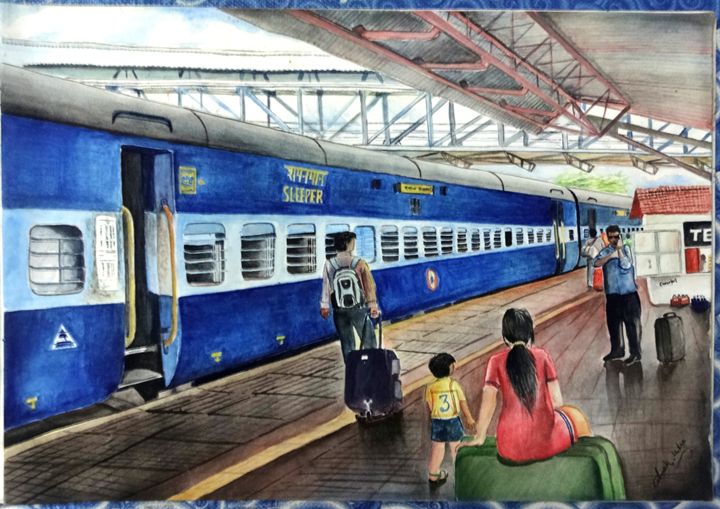
QUINTUPLETS: TRAVELING WITH STRANGERS

Image result for train painting india

These are five 110 word travel stories with a twist originally written for a challenge in Sulekha. Be candid and not candied in your comments.


Story No.1

As Venad Express was pulling out of the station, a young man clutching his briefcase leaped through the door. He stood puffing but victorious, mopping the sweat from his forehead, as the train gathered momentum. An older man on the train watched him with disdain.
”You young people don’t keep yourself in shape,” he said scornfully. “Why, when I was your age, I could carry a cup of coffee in one hand and run half a mile to catch the 7:30 in the nick of time and still be fresh as a daisy”
“You don’t understand”, panted the young man. “I missed this train at the last station!”
(110 words)

Story No.2

The stylish old man in impeccable suit sat next to me when he boarded the U-Bahn from Vienna. I was perusing the map to locate Schwedenplatz station to see the river Danube. Frustrated, I sought his help, but he replied that he would alight at a station before mine.
He described in advance the scenery I would see from my window–first the peach orchard, then the birch mountain, then oak alley….
Finally, the train halted at his station.
As I was helping him off the train, a young man, trying to get in, jostled him.
‘Would you let this blind man off first?’, the old man implored.
(108 words)

Story No.3

The Coromandel Express was approaching Cuttack station. The 2nd class compartment was empty except for him and the middle aged lady in deep slumber with a gold chain adorning her neck.
He needed a gift for his beloved for their 25th wedding anniversary. Business had turned him into a destitute. He vacillated and then in a sudden urge ripped that gold chain.
He was about to move away, when he heard a voice behind him, “If you will accept, I have a thicker one. It is a bit plain but one that fits all.”
He turned to see the lady with a handcuff and a pistol.
(107 words)

Story No.4

Panhandlers, of myriad categories, have always been a nuisance to commuters in the Flying Rani express. I generally avoid them. I was on my usual weekend trip to Mumbai from Surat. A young girl with beautiful blue eyes was collecting alms for the Lathur earthquake victims. When she approached me, with a flourish I pulled out a few notes from my wallet and placed it in her bowl.
“Two hundred rupees for your blues eyes”, I said looking into her lustrous eyes.
She smiled coyly, took the notes and put it in her pocket.
‘Now sir, could you give something for the quake victims as well?’
 (106 words)

Story No.5

It was his first day in Saudi. He was on a bus to the office. He spotted a pink palatial house and asked the Saudi co-passenger,
“Do you know whose house that is?”
The Saudi looked out and replied, ‘Mahdri’
Soon they came upon an even bigger sprawling mansion.
“Do you know who owns that?”
“Mahdri” came the reply.
The same query and the same reply over and over again, only increased our Indian’s admiration for Mahdri.
Mahdri must indeed be a big business tycoon.
A month later, he asked a smart Saudi who this ‘Mahdri’ was.
He replied, “My dear fellow, ‘Mahdri’ in Arabic means ‘I don’t know’ “
(109 words)

BITS OF BEAUTY

Wordsworth, in his beautiful poem ‘Daffodils’, rapturously narrates how his heart was imbued with infinite happiness at the sight of a sea of daffodils. For him, daffodils symbolized the joys and happiness of life.

I wander’d lonely as a cloud
That floats on high o’er vale and hills,
When all at once I saw a crowd,
A host of golden daffodils:
Beside the lake, beneath the trees,
Fluttering and dancing in the breeze


There are many occasions in our life when we are exposed to fleeting visions of beauty that adds enchantment to our mundane existence. I recently read the following passage written by Maupassant in an essay collection and was struck by it. I wanted to utter ‘carpe diem’ and thought to jot down some lines on its import.

From time to time I experience strange, intense, short-lived visions of beauty, an unfamiliar, elusive, barely perceptible beauty that surfaces in certain words or landscapes, certain colorations of the world, certain moments….I’m not able to describe or communicate it, I can’t express it or portray it. I save these moments for myself….I have no other reason for continuing, no other cause for keeping on….” (G. Maupassant- French short story writer, famous for his story –“The Necklace”)

I believe all our lives are replete with such “strange, intense, short-lived visions of beauty”. Mortal and immortal moments mingle in abundance in our everyday existence. It could be the smile of a destitute, the alluring voice of someone you talked to on a dreary day, an old couple in romantic embrace on a beach at sunset, the spotting of a full moon as you drive home in a hurry, a tawdry artefact that lingers in your memory on a visit to an ordinary home, the glow a tomato like a red lantern in a vegetable shop, an itinerant musician intensely involved in playing a violin at a subway station. The list is endless. Your mind gleefully captures and retains it to beam before you on a day when you search for a blade of grass to smile at. In such moments one experiences something incomprehensible and piercing, both extravagant and absolutely fundamental.

Wordsworth in the last stanza of the same poem condenses this evocative and restorative power of beauty as follows:

In vacant or in pensive mood,
They flash upon that inward eye
Which is the bliss of solitude;
And then my heart with pleasure fills,
And dances with the daffodils


We can see such shards of beauty even in  boring films and novels, a vision that visits again, a line that delineates something essential about life. Without these momentary beauties, life could be appallingly intolerable.

Perhaps these ephemeral revelations of beauty are coupled in a strange way with melancholy moments. Yet in retrospect, they bring a smile than sneer. We don’t truly know what causes beauty though grief may be more explainable.

This mixture of impermanence and permanence, the blending of what vanishes and what remains, is a blissful ingredient of our reality. Let the glow of such brief and beautiful moments act as our cheerleaders.


A DATE WITH DAVID


 ‘Oh! You’re going to Italy. Beware of pickpockets’, my globe-trotting friend warned us.
 We are in Florence. My friend’s words keep ringing in my head. I am obsessed with my left back pocket so much that my left hand is stuck to my left butt.
We enter Academia Gallery… tourists teem before Michelangelo’s ‘David’, the most beautiful statue ever crafted by human hand. With my left hand on my left pocket, I am devouring ‘David’.. his burning eyes, seductive lips and adorable anatomy. My wife vanishes into the crowd. My younger son nags me to give 1€ to view ‘David’ through a televiewer.. The crowd surges forward..Click..Click …and my left hand goes to my left pocket and I feel a numbing emptiness…
I cry out….Thief! thief! My wallet is gone! My wallet!…
My wife rushes in and shouts
‘Oh PGR, it’s there in your right hand!’
Apparently, I had taken it out to give money to my son and kept it in my right hand

(165 words)

5-55: BABY TALES

These are ‘55’ words micro fiction written by me during a creative collaboration contest in Sulekha.

LOVE
It was after months that they were having this rapturous rendezvous. They couldn’t control any longer and disappeared behind the green cover of bamboos, which offered camouflage,   to quench their lust. It was then she sensed a tremor and noticed a man videotaping them.  “Get lost idiot! We too need privacy”, the lady parrot hollered.

JEALOUSY
She was younger, taller, smarter and prettier. She was everything that I longed to be but could not. I repeatedly downplayed her but she emerged more confident with a strange vengeance. Gradually my husband started getting closer to her. That is when I regretted for the first time the creation of her – our daughter.

HATRED
She opened the mail box with a sigh.

26th January…Dying to see you!

Click! Delete

8th March…Forever yours!

Click!

4th April…My Sweetie

Click! And she moved on, gliding the cursor over each subject line, pressing DELETE.

Red eyes aching. Pale lines vanishing.

She paused. A photo!  His rapturous embrace….

Click! Click! Click! Click!
Delete Account.

GREED
As a prolific blogger, her blogs always topped in the most commented section in Sulekha . She had just completed her 500th blog. After her incessant persuasion to be bloggers, we joined Sulekha and sought her advice to begin blogging.  She politely said, ‘Do blog to your heart’s content, but comment only on mine.

PHILANDERING
Where is the belly ring I bought you? John asked
Mary fumbled.
John took out the ring with “MJ” inscribed on it from his pocket.
Mary gasped. “Where did you find this dear”?
“I got it from Sophie’s” , John quipped. “Edward had gone there straight from here “
Both stared in long silence

Remarks:
All creation is a process of destruction. There is one which I feel can be classified into the off grade category. I post it below
HATRED-2
He was dying.
I softly said, “I had long waited to be near you’.
His eyes flashed open  and fumed liked a volcano
I sensed the eruption of hatred from his eyes and his gasping, convulsive mouth.
Smilingly, I poured a spoonful of water into his mouth.
He swallowed the liquefied hatred and passed away.


UNEXPECTED REUNION

By Johann Peter Hebel
Translated by John Hibberd
(The story extolled by Kafka as the most wonderful story in the World)

At Falun in Sweden, a good fifty years ago, a young miner kissed his pretty young bride-to-be and said, ‘On the feast of Saint Lucia the parson will bless our love and we shall become man and wife and start a home of our own’. ‘And may peace and love dwell there with us’, said his lovely bride, and smiled sweetly, ‘for if you are everything to me, and without you I‘d sooner be in the grave than anywhere else’. ‘When however, before the feast of Saint Lucia, the parson had called out their names in the church for the second time: ‘If any of you know cause, or just hindrance, why these two persons should not get joined together in holy Matrimony’ -Death paid a call. For the next day when the young man passed her house in his black miner’s suit (a miner is always dressed ready for the funeral), he tapped at the window as usual and wished her good morning all right, but he did not wish her good evening. He did not return from the mine, and in vain that same morning she sewed a red border on a black neckerchief for him to wear on their wedding day, and when he did not come back she put it away, and she wept for him, and never forgot him.
In the meantime the city of Lisbon in Portugal was destroyed by an earthquake, the Seven Years War came and went, the Emperor Francis I died, the Jesuits were dissolved, Poland was partitioned, the Empress Maria Theresa died, and Struensee was executed, and America became independent, and the combined French and Spanish force failed to take the Gibraltar. The Turks cooped up General Stein in the Veterane Cave in Hungary, and the Emperor Joseph died too. King Gustavus  of Sweden conquered Russian Finland ,the French Revolution came and the long war began, and the Emperor Leopold  II was buried. Napoleon defeated Prussia, the English bombarded Copenhagen, and the farmers sowed and reaped. The millers ground the corn, the blacksmiths wielded their hammers, and the miners dug for seams of metal in their workplace under the ground.
But in 1809, within a day or two of the feast of Saint John, when the miners at Falun were trying to open up a passage between two shafts, they dug out from the rubble and the vitriol water, a good three hundred yards below the ground, the body of a young man soaked in ferrous vitriol but otherwise untouched by decay and unchanged, so that all his features and his age were still clearly recognizable, as if he had died only an hour before or had just nodded off at work. Yet when they brought him to the surface his father and mother and friends and acquaintances were all long since dead, and no one claimed to know the sleeping youth or to remember his misadventure, until the woman came who had once been promised to the miner who one day had gone below and had not returned. Grey and bent, she hobbled up on a crutch to where he lay and recognized her bridegroom, and more in joyous rapture than in grief, she sank down over the beloved corpse, and it was some time before she had recovered from her fervent emotion. ‘It is my betrothed’, she said at last, ‘whom I have mourned these past fifty years, and now God grants that I see him once more before I die. A week before our wedding, he went under ground and never came up again’. The hearts of all those there were moved to sadness and tears when they saw the former bride-to-be as an old woman whose beauty and strength had left her, and the groom still in the flower of his youth; and how the flame of young love was rekindled in her breast after fifty years, yet he did not open his mouth to smile , nor his eyes to recognize her; and how finally she, as the sole relative and the only person who had claim to him, had the miners carry him into her house until the grave was made ready for him in the churchyard.
The next day when the grave lay ready in the churchyard and the miners came to fetch him she opened a casket and put the black silk kerchief and red stripes on him, and then she went with him in her best Sunday dress, as if it were her wedding day, not the day of his burial. You see, as they lowered him into his grave in the churchyard she said, “Sleep well for another day or a week or so longer in your cold wedding bed, and don’t let time weigh heavy on you! I have only a few things left to do, and I shall join you soon, and soon the day will dawn’.
‘What the earth has given back once it will not withhold again at the final call’, she said as she went away and looked back over her shoulder once more.
Postscript
It was  couple of years ago while reading Elias Canetti’s (1981 Nobel Prize Winner for Literature) autobiography, ‘The tongue set free’, that I came across the mention of this story which Franz Kafka had hailed as ‘most wonderful story in the world’. This story appears in the German writer Johan Peter Hebel’s (1760-1826) only story collection titled, “The Treasure Chest”.  I am glad that I lived to read this story which I too consider as one of the rare gems in literature.

Walter Benjamin once made the striking claim, when writing about Hebel, that “death is the sanction of everything that the storyteller can tell. He has borrowed his authority from death.” He was referring particularly to the story “Unexpected Reunion”.

Hermann Hesse called Hebel’s book ‘The Treasure Chest’ ,  ‘a summit and jewel of German narrative prose’; and Elias Canetti said ‘I don’t believe there’s a book in the world that engraved itself on my mind as perfectly and as minutely as this one.’ He “secretly” measured each of his books against Hebel’s style. ‘The Treasure Chest’ is not unlike a child’s box of treasures, and that is part of its charm. It inspires uncommon fondness in the first reading itself .Its contents are unpretentious and they are presented with such an allure that even the most sophisticated of readers may accept them too with a smile of pleasure.
The sheer variety and brevity of his stories (some as brief as a paragraph) is amazing. They are simple and agreeable to even a casual reader .They include weird, funny, touching and good-humoured ones too.  Hebel had as sure a grasp of the world as he had of the way to amuse his readers. Nearly two hundred years after he wrote his stories, you’ll get the point of Hebel in about a minute. No wonder,  Hebel’s admirers included Goethe, Tolstoy and the brothers Grimm.
Hebel posessed unique style and aesthetic tricks. The key point  is that he succeeded in describing simple people and made a meaningful order of the world shine through their everyday actions. In every detail, he had the whole in view. This “holistic” trait of his writings is very contemporary.
I remembered this story only a day after Valentine’s Day (Perhaps this is the best Valentine’s story ever written by anyone). This is the first time this story is made available in the internet and I am glad of it (The world is still not awake to savor this most beautiful story). But,  if there are any copyright issues, I may delete this post without any compunction. So save your copy now!

(The picture posted at the beginning is the scanned image of the  sketch that accompanies the story)

Do read all comments as I have chipped in my thoughts on the story in the comments section. Your discussion on this story will enrich this blog.