
THE OAK AND THE LINDEN
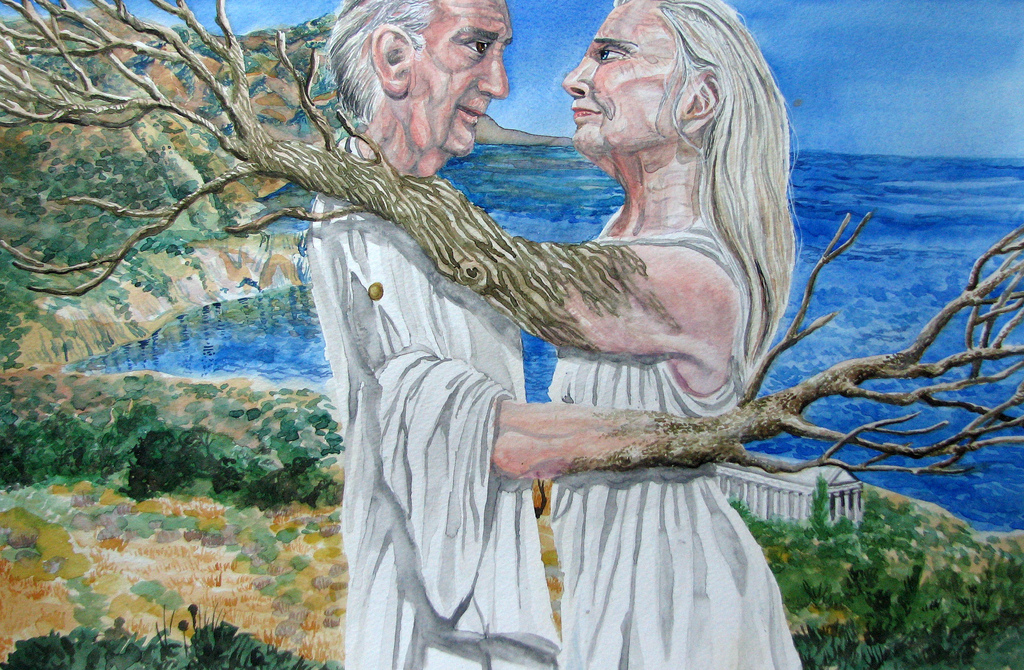
There was once a good old couple who lived in a little cottage upon a hilltop. Baucis and Philemon were their names, and, although they were very poor, they tended their bees, and pruned their grape vine, and milked their one cow, and were happy from morning till night. For they loved each other dearly, and they were ready to share whatever they had with any one in need.
At the foot of the hill lay a beautiful village, with pleasant roads, and rich pasture lands all about it; but it was full of wicked, selfish people, who had no love in their hearts, and thought only of themselves.
One evening, as Baucis and Philemon sat in their cottage door, they saw two strangers coming slowly up the hill. There was a great noise of shouting, and the barking of the dogs from the village, for the people were following the strangers, and jeering at them because they were footsore, and ragged, and weary.
“Let us go to meet them,” cried old Baucis, “and ask them to share our supper, and stay with us for the night.”
So Baucis and Philemon brought the strangers, who were quite faint for food, to their cottage, and they spread before them all that they had, which was very little—a half a loaf of brown bread, a tiny bit of honey from their own hives, and a pitcher of milk. The pitcher was only partly full, and when Philemon had filled two bowls for the strangers, there was but a drop left.
The strangers ate as if they had never tasted anything as good, although the supper was exceedingly small.
“More of this delicious milk, Philemon!” cried one of the strangers, and, as Philemon took the pitcher to drain the last drop into the bowl, a wonderful fountain of milk burst forth from the bottom of the pitcher, so that the more she poured the more there remained.
And it was so with the loaf, which stayed always the same size, although the two strangers cut slice after slice, praising Philemon for its sweetness and lightness. The honey grew the color of gold, and sweeter each minute; and the single, tiny bunch of grapes grew to a bunch of such size that the strangers were not able to eat it, and the grapes filled all the cottage with their wonderful fragrance.
“These are strange travelers!” whispered the old couple to each other, “who are able to do such marvellous things.”
That night Baucis and Philemon slept upon the floor, that the strangers might have their bed; and in the morning they went to the edge of the hill to see the strangers safely started on their homeward way.
“The villagers are thoughtless and rude,” said Baucis. “I hope they may not torment you again, good sirs.”
But the strangers smiled, and pointed to the foot of the hill. There was no village there. Where it had stood a blue lake rippled, covering, with its clear waters, the houses and the trees. Baucis and Philemon rubbed their eyes in wonder.
“People with no love in their hearts shall not live upon the earth,” said the strangers. “As for you, my good people, we thank you; and whatever you wish for most, that shall be given you.”
As they spoke, the strangers vanished from sight, like mist in the morning sky; and Baucis and Philemon turned to see that their tiny cottage had disappeared also, and in its place stood a tall, white marble palace, with a beautiful park all about.
So the old couple went in, and they lived in their palace a great, great while, taking good care of their wonderful pitcher. No one ever passed their door without having a drink from the bubbling fountain of milk, and Baucis and Philemon were so happy doing good deeds for others that they never thought of wishing for anything for themselves.
But, after years and years had passed they grew very old.
“I wish we might never die, but could always stay together!” said Baucis, one day, to Philemon.
The next morning, where the tall marble palace had stood, there was nothing save a few stones with the moss growing over them; Philemon and Baucis were gone; but there, on the hilltop, stood two beautiful trees—an oak tree and a linden—with their branches all twined and twisted together.
“I am old Baucis!” whispered the oak.
“I am Philemon!” sighed the linden—and there they stand to-day, quite close to each other, and always ready to spread their leafy shade over every tired stranger who chances to climb the hill.
…………………………………………………………………………………………….
You may now read the beautiful lines from a famous poem titled “Letter of Testimony” by Octavio Paz as it extols the creative power of love.
Coda
Perhaps to love is to learn
to walk through this world.
To learn to be silent
like the oak and the linden of the fable.
To learn to see.
Your glance scattered seeds.
It planted a tree.
I talk
because you shake its leaves.
(Translated by Eliot Weinberger)
The first few phrases of the poem are a sort of definition (if such a thing were possible) of love; like any great poet, Paz presents a wholly new way of looking at his subject. I especially like the line “to love… is to learn to be silent” – it conveys a truth lost in many more verbose descriptions of the emotion.
The silence of the forest (“the oak and the linden of the fable”) leads naturally into the analogy of the second half:”Your glance scattered seeds / It planted a tree”. Again, the metaphor is neither forced nor is it taken too far; the final line comes as a natural (and beautiful) conclusion to the whole.
Notice how the rather abstract infinitives with which ‘Coda’ starts (to love, to learn, to walk, to see, to be silent) give way to more concrete actions later on – ‘scattered’, ‘planted’, ‘talk’ and ‘shake’. The result is to move the poem from the general to the specific: from a discussion of ‘Love’ as an abstract concept, to words and sentences addressed directly to the poet’s beloved. This is a fairly common poetic device, but one no less pleasing for that; I like the delicate and unobtrusive skill with which it’s done in this poem.
Octavio Paz (my favorite poet) was the foremost Mexican poet of the 20th century. He won the Nobel Prize for literature in 1990. He was also the former Mexican Ambassador to India. I had featured earlier two of his works, “The Blue Bouquet” and “January First” .
Ref: The collected poems of Octavio Paz, 1957-1987 By Octavio Paz, Eliot Weinberger (Page 635)

 pgrnair.com