THE BEAUTIFUL DAY

THE BEAUTIFUL DAY

By Jean Follain ( French Minimalist poet)
Translated by Heather McHugh

Insects and fish
move from the shade to the light
the fruit hangs still on the tree
brushed by the fine wing
of a flamboyant bird
then a dull one.
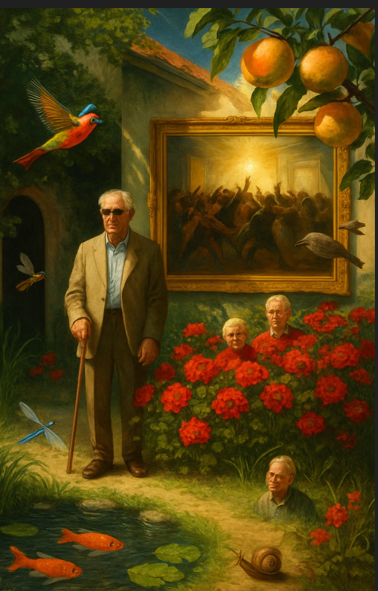
The blind man hardly thinks
of his missing eyes
in the garden of wine-red flowers.
Suddenly the sun in the drawing room
lights a large painting that shows
rioters surging wildly into sight.

A delicate and layered poem, “The Beautiful Day” uses serene imagery and subtle shifts in tone to reflect on how easily tranquility can be shadowed by unseen violence or remembered suffering. It unfolds with a deep awareness of contrast—between serenity and disturbance, the visible and the hidden, nature and human turmoil. It’s a meditation on the fragility of peace and the haunting presence of what lies beyond the beautiful moment.

By moving from a garden’s quiet details to a painting of rioters lit up indoors, the poem subtly asks us about what we see, what we miss, and how sudden revelations (of violence, of reality) change the character of a peaceful day. It’s a poem about beauty and disturbance, perception and ignorance, outer calm and inner turmoil.

Heather McHugh in her introduction says the following about the poem:

“And in “The Beautiful Day,” the aristocratic idleness of the garden (appearing for all the world—*brushed,” posed—like the subject of a more romantic art) is disturbed by the image of the insurgent mob in a living-room painting. Which is more alive, more real? We feel we know. We know we feel. Still, the man in the garden is blind. The seer is present in these poems not as the fashionably poetic first person but rather as the subverted designer of the seen. We, the readers, have a place here too. Is it we who lull, senseless, in the garden of the decorative, blind to the blood in the living room? The poem s both subject and object here.”

Source : D’Apres Tout: Poems by Jean Follain. Image created using AI)
KEEP IN MIND

KEEP IN MIND

Halina Poświatowska (Polish Lyric poet)
Translated by Maya Peretz

if you die
I won’t put on a lilac dress
won’t buy colored wreaths
with whispering wind in the ribbons
none of that
none

the hearse will come — will comethe hearse will go — will go
I’ll stand at the window — I’ll look
wave my hand
flutter my handkerchief
bid farewell
alone in that window

and in summer
in crazy May
I will lie down on the grass
warm grass
and with my hands will touch your hair
and with my lips will touch a bee’s pelt
prickly and beautiful
like your smile
like dusk

later it will be
silver — golden
perhaps golden and only red
for that dusk
that wind
which whispers love into grasses
stubbornly whispers love
will not allow me to rise
and go
so simply
to my cursed deserted house

(From : Indeed I love… : Selected Poems of Halina Poświatowska)

Poświatowska is famous for her lyrical poetry, and for her intellectual, passionate yet unsentimental poetry on the themes of death, love, existence, famous historical personages, especially women, as well as her mordant treatment of life, living, being, bees, cats and the sensual qualities of loving, grieving and desiring. (Wiki). Sadly, she died at the age of 32.

This poem is a quietly devastating meditation on grief, love, memory, and the raw, unresolved emotions that accompany loss. In a style that is both intimate and elusive, she rewrites the rituals of mourning into something more personal, elemental, and sensual.

The tone is restrained and almost dispassionate at first — “if you die / I won’t put on a lilac dress” — rejecting traditional mourning practices and ceremonial grief. But under the surface, this emotional flatness conceals a profound depth of love and vulnerability. The voice is solitary, meditative, and deeply personal — as if the speaker is speaking not to us, but directly to the beloved (possibly already lost).

The poem is built in two parts: the first coolly dismisses outward mourning rituals; the second opens into a lyrical outpouring of natural imagery that becomes the speaker’s private language of grief. Rather than the expected flowers and ribbons — “colored wreaths / with whispering wind in the ribbons” — she offers a stark image of detachment: standing alone at the window, waving a handkerchief. But then, in the second half, she transforms grief into a tactile communion with nature:

“I will lie down on the grass / warm grass / and with my hands will touch your hair / and with my lips will touch a bee’s pelt”

Here, Poświatowska fuses the sensory world — grass, bees, hair, wind — with the emotional and metaphysical. The bee’s pelt, “prickly and beautiful,” becomes a metaphor for the beloved’s smile, for the sting and sweetness of memory. The dusk, golden and red, echoes the complexity of letting go — a moment suspended between light and darkness.The final lines resist closure. Even the wind becomes an accomplice, “whispers love into grasses / stubbornly whispers love.” This persistent whisper of love paralyzes the speaker — she cannot “rise and go / so simply.”

Like John Donne, Poświatowska offers a deeply sensual and metaphysical approach to mourning, where nature becomes both witness and medium of love and grief. KEEP IN MIND is a tender rebellion against formal rituals, and a haunting portrait of loss — not as an ending, but as a transformation of love into something eternal, diffused into the elements.

TABLE

Table
by EDIP CANSEVER (Turkish Poet)
translated by Julia Clare Tillinghast and Richard Tillinghast

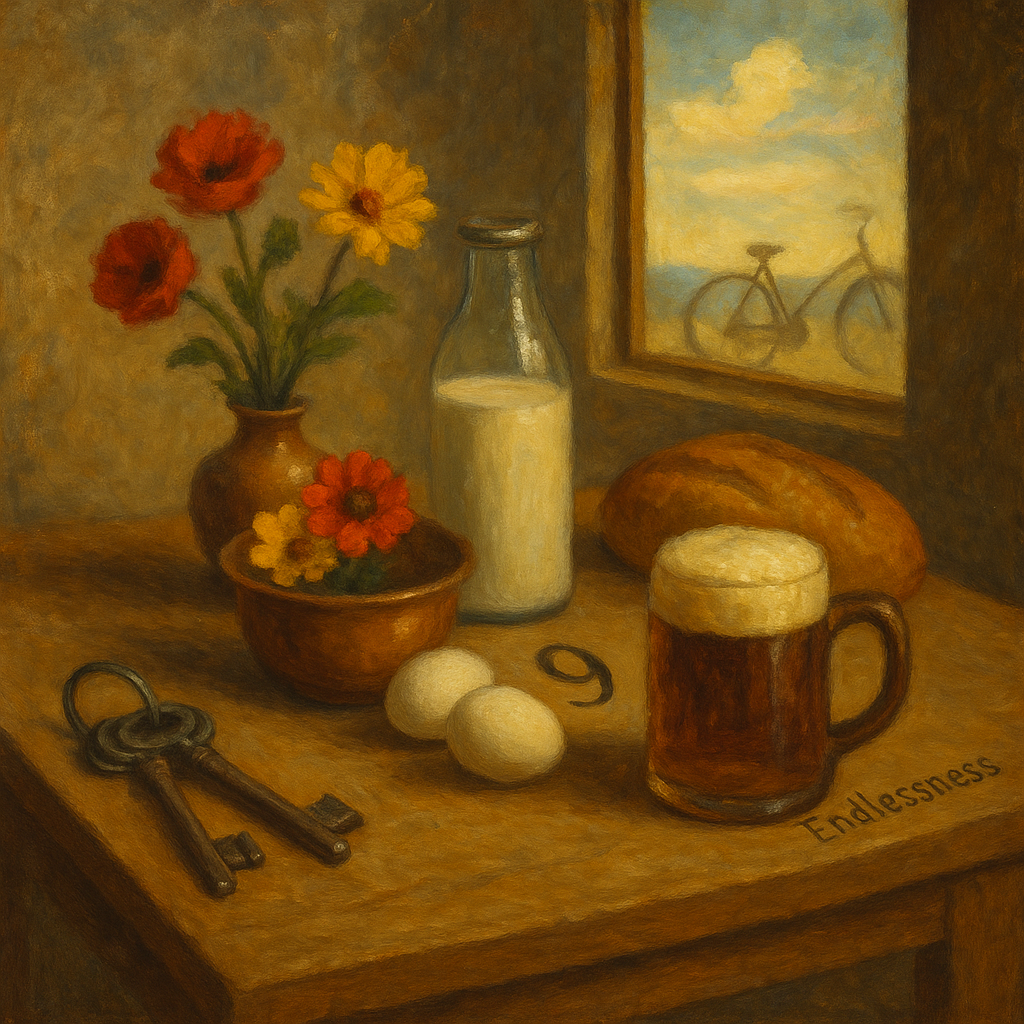
A man filled with the gladness of living
Put his keys on the table,
Put flowers in a copper bowl there.
He put his eggs and milk on the table.
He put there the light that came in through the window,
Sound of a bicycle, sound of a spinning wheel.
The softness of weather and bread he put there.
On the table the man put
Things that happened in his mind.
What he wanted to do in life,
He put that there.
Those he loved, those he didn’t love,
The man put them on the table too.
Three times three make nine:
The man put nine on the table.
He was next to the window next to the sky;
He reached out and placed on the table endlessness.
So many days he had wanted to drink a beer!
He put on the table the pouring of that beer.
He placed there his sleep and his wakefulness;
His hunger and his fullness he put there.
Now that’s what I call a table!
It didn’t complain at all about the load.
It wobbled once or twice, then stood firm.
The man kept piling things on.

From Dirty August: Poems by Edip Cansever, translated by Julia Clare Tillinghast and Richard Tillinghast Jersey City, NJ: Talisman House, 2009

This fascinating poem is a poetic listing — a catalogue of the self. The act of putting things on the table becomes a ritual of unburdening, of both confession and celebration. It starts with piling up of essentials that brought joy to the poet’s life. The table soon becomes a microcosm of a life — joys, regrets, hunger, memory, love, rejection, longing — all coexist. I believe everyone has such a table.

Edip Cansever’s poem “Table” is a deeply evocative and symbolic celebration of life, memory, and the human experience — all unfolding on a simple, unassuming piece of furniture: a table. With deceptive simplicity and a meditative rhythm, Cansever turns a household object into a repository of emotion, desire, thought, and even the metaphysical.

The poem uses free verse, lending it a conversational tone, almost like a stream of consciousness. The repetitive phrase “he put” creates a rhythm and builds a cumulative effect — each object placed on the table adding to the complexity of the speaker’s inner and outer worlds. The tone is reflective, sometimes playful, but increasingly profound as abstract ideas begin to mingle with physical things. There’s a quiet reverence toward the ordinary, transforming the mundane into something sacred.

Cansever begins with concrete, everyday items:“Put his keys on the table, / Put flowers in a copper bowl there.” As the poem progresses, he layers sensory perceptions (“light,” “sound”), then moves into the intangible:“Things that happened in his mind… / What he wanted to do in life.” Eventually, the poet arrives at the cosmic — placing “endlessness” itself on the table. This evolution from the simple to the sublime echoes human consciousness and our natural tendency to attach meaning to the ordinary.

Edip Cansever’s “Table” is a meditative marvel — a still life that moves. The poem does not preach or dramatize but simply places before us the quiet abundance of living. In its simplicity lies its profundity. The final image — of the table, firm despite its load — becomes a poetic monument to human resilience, memory, and the art of noticing. This is a poem that doesn’t ask to be analysed so much as inhabited, much like the table itself — inviting us to place our own “pouring of beer,” our “softness of bread,” and our “endlessness” on it, and see how it holds.

What would your table be?

The Half-Finished Heaven

The Half-Finished Heaven

By Tomas Tranströmer

Translated by Robin Fulton

Despondency breaks off its course.
Anguish breaks off its course.
The vulture breaks off its flight.

The eager light streams out,
even the ghosts take a draught.

And our paintings see daylight,
our red beasts of the ice-age studios.

Everything begins to look around.
We walk in the sun in hundreds.

Each man is a half-open door
leading to a room for everyone.

The endless ground under us.

The water is shining among the trees.

The lake is a window into the earth.

Tomas Tranströmer’s The Half-Finished Heaven is a luminous and redemptive poem that captures the sudden breaking of despair by glimpses of hope and illumination. The Swedish Nobel laureate, known for his sparse but emotionally rich language, distills a vast emotional and spiritual shift into just a few carefully chosen images and lines.

The poem opens in darkness — with “despondency,” “anguish,” and even a “vulture” — symbols of death, hopelessness, and sorrow. But this heaviness is disrupted. The phrase “breaks off its course” suggests that suffering, though powerful, is not endless. There is an abrupt, almost miraculous intervention: “The eager light streams out.” It’s not passive light but eager — hungry to redeem, to touch, to restore.

From that turning point, the world awakens. Even “ghosts,” symbols of lingering sorrow or memory, are revived — “take a draught” — as if nourished by the new light. Tranströmer then introduces metaphors of art: “our paintings see daylight,” and “red beasts of the ice-age studios.” These suggest that even what was buried deep within human history or psyche — our primal instincts, ancient creations — are returning to view, revitalized.

The lines “Each man is a half-open door / leading to a room for everyone” are especially powerful. They evoke the possibility of connection, empathy, and community. We are not complete or perfect (“half-open”), but we are entryways to something larger, something hospitable. This idea makes the title The Half-Finished Heaven feel apt — the world is incomplete but leaning toward beauty and redemption.

The closing lines bring in elements of nature: “The water is shining among the trees,” and “The lake is a window into the earth.” These observations feel sacred — as though the earth itself is opening up to understanding.Overall, The Half-Finished Heaven is a quietly stunning meditation on the

Traveling with Strangers

QUINTUPLETS: TRAVELING WITH STRANGERS

Here are five 110 word story with a twist

Story No.1

As Venad Express was pulling out of the station, a young man clutching his briefcase leaped through the door. He stood puffing but victorious, mopping the sweat from his forehead, as the train gathered momentum. An older man on the train watched him with disdain.

”You young people don’t keep yourself in shape,” he said scornfully. “Why, when I was your age, I could carry a cup of coffee in one hand and run half a mile to catch the 7:30 in the nick of time and still be fresh as a daisy”

“You don’t understand”, panted the young man. “I missed this train at the last station!”

(110 words)

Story No.2

The stylish old man in impeccable suit sat next to me when he boarded the U-Bahn from Vienna. I was perusing the map to locate Schwedenplatz station to see the river Danube. Frustrated, I sought his help, but he replied that he would alight at a station before mine.

He described in advance the scenery I would see from my window–first the peach orchard, then the birch mountain, then oak alley….

Finally, the train halted at his station.

As I was helping him off the train, a young man, trying to get in, jostled him.

‘Would you let this blind man off first?’, the old man implored.

(108 words)

Story No.3

The Coromandel Express was approaching Cuttack station. The 2nd class compartment was empty except for him and the middle aged lady in deep slumber with a gold chain adorning her neck.

He needed a gift for his beloved for their 25th wedding anniversary. Business had turned him into a destitute. He vacillated and then in a sudden urge ripped that gold chain.

He was about to move away, when he heard a voice behind him, “If you will accept, I have a thicker one. It is a bit plain but one that fits all.”

He turned to see the lady with a handcuff and a pistol.

(107 words)

Story No.4

Panhandlers, of myriad categories, have always been a nuisance to commuters in the Flying Rani express. I generally avoid them. I was on my usual weekend trip to Mumbai from Surat. A young girl with beautiful blue eyes was collecting alms for the Lathur earthquake victims. When she approached me, with a flourish I pulled out a few notes from my wallet and placed it in her bowl.

“Two hundred rupees for your blues eyes”, I said looking into her lustrous eyes.

She smiled coyly, took the notes and put it in her pocket.

‘Now sir, could you give something for the quake victims as well?’

 (106 words)

Story No.5

It was his first day in Saudi. He was on a bus to the office. He spotted a pink palatial house and asked the Saudi co-passenger,

“Do you know whose house that is?”

The Saudi looked out and replied, ‘Mahdri’

Soon they came upon an even bigger sprawling mansion.

“Do you know who owns that?”

“Mahdri” came the reply.

The same query and the same reply over and over again, only increased our Indian’s admiration for Mahdri.

Mahdri must indeed be a big business tycoon.

A month later, he asked a smart Saudi who this ‘Mahdri’ was.

He replied, “My dear fellow, ‘Mahdri’ in Arabic means ‘I don’t know’ “

(109 words)